


Why cassette material is not a secondary specification
In histology procurement, people often treat the embedding cassette as a low-risk consumable and focus their technical review on dimensions, lid style, or printer compatibility. That misses the real point. The material of an embedding cassette affects how the cassette behaves through fixation, dehydration, clearing, paraffin infiltration, sectioning preparation, and long-term archive handling. If the plastic softens, warps, cracks, or interferes with labeling at any of those stages, the problem does not stay with the cassette. It becomes a sample traceability issue.
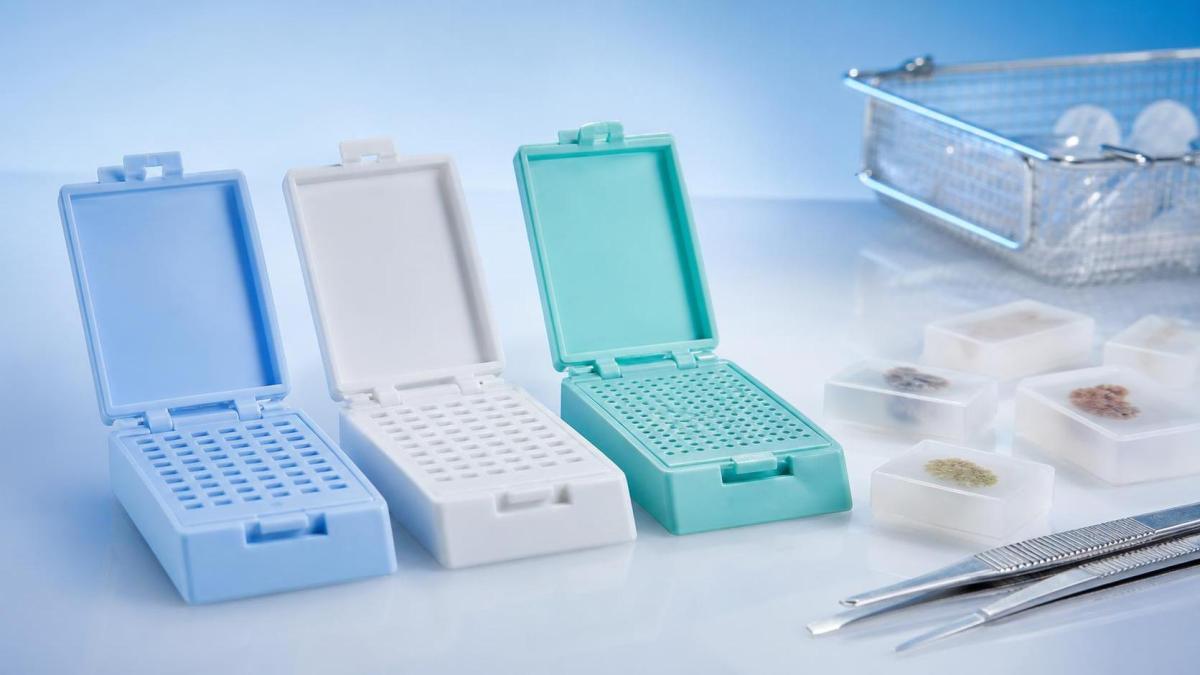
This is why PP, POM, and biopsy-oriented cassette designs are usually evaluated together rather than as isolated options. They answer different risks. PP is often chosen for broad routine use because it balances chemical resistance, process stability, and cost. POM is commonly considered when higher rigidity or tighter dimensional stability is needed. Biopsy types are not simply “smaller-hole cassettes”; they are intended to reduce tissue loss and improve containment for small or fragmented specimens, especially when handling delicate cores or tiny biopsies.
The practical question is not which one is best in abstract terms. It is which cassette remains reliable under a lab’s actual reagents, processor settings, labeling method, and specimen mix.
PP and POM are chosen for different failure modes
Polypropylene and polyoxymethylene are both established engineering plastics, but they are not interchangeable in use. A technical evaluator usually looks at three things first: thermal behavior during processing, resistance to routine reagents, and mechanical performance during handling and embedding.
PP is widely used because it generally performs well in routine histology workflows involving formalin-fixed tissue and standard paraffin embedding programs. It is lightweight, chemically resistant in many common laboratory conditions, and suitable for high-volume use. In practice, a good PP cassette tends to be forgiving. It can support daily workflow without demanding unusually narrow process windows.
POM, by contrast, is valued for stiffness and dimensional precision. Labs that prioritize crisp locking behavior, structural rigidity, or reduced flex during loading may prefer it for specific processor setups or handling habits. That said, “more rigid” does not automatically mean “better.” In some workflows, excessive emphasis on rigidity can hide other concerns, such as compatibility with the exact solvents, wax temperatures, or printing conditions used in the facility.
What matters is not the resin name by itself but the finished product behavior. Mold quality, vent design, hinge geometry, surface finish, and manufacturing consistency can outweigh generic assumptions about the polymer. Two PP cassettes from different suppliers may perform less alike than a buyer expects.
Biopsy cassettes solve containment problems, not material problems alone
Biopsy types deserve separate attention because they are designed around specimen retention. That usually means smaller apertures, finer perforation patterns, or compartment-style layouts intended to reduce the chance that tiny tissue fragments escape during processing. For gastrointestinal biopsies, needle cores, or fragmented tissue, this is more than a convenience feature.
A common mistake is to compare a biopsy cassette to a standard cassette only by external dimensions or material. In reality, hole size, fluid exchange efficiency, lid security, and the use of adjuncts such as biopsy pads all change the performance profile. If perforations are too large, specimen loss becomes the obvious risk. If they are too restrictive, reagent circulation may be less effective for certain tissue loads or processor conditions. The right balance depends on the specimen category and the laboratory’s validated workflow.
This is where evaluators should ask a more disciplined question: is the cassette intended to maximize throughput for routine blocks, or to minimize risk for small and vulnerable specimens? Those are related goals, but not the same one.
Labeling reliability is part of material assessment
In export discussions, buyers often ask about reagent compatibility first and marking performance later. In practice, the order should be reversed or at least equal. A cassette that survives processing but loses readability creates a different kind of nonconformity. Material surface characteristics influence how well the cassette accepts laser marking, inkjet printing, or thermal transfer identification. That includes print contrast, smearing resistance, and readability after exposure to solvents, heat, wax, and storage handling.
For technical review, it is worth checking whether the label field remains flat, whether molded surfaces interfere with print uniformity, and whether the chosen plastic shows visible change after the lab’s standard process cycle. These details are easy to dismiss during bench inspection and much harder to recover once large batches are deployed.
The same logic applies across other laboratory tools. A measuring device can meet its nominal function yet still be a poor fit if it does not align with workflow conditions. That is why some laboratories still keep reusable calibrated glassware such as Measuring Pipettes, Glass for precise measuring and dispensing tasks where material behavior, sterilization method, and standard compliance such as ISO 835 must all be considered together rather than separately.
What technical evaluators should actually verify
A useful evaluation does not start from a catalog description. It starts from the lab’s own process map. At minimum, the review should include:
- processor temperatures and paraffin infiltration conditions;
- the reagent set used in routine tissue processing;
- specimen mix, especially the proportion of small biopsies versus routine surgical tissue;
- printing or marking technology and post-processing readability requirements;
- mechanical checks on hinge closure, stackability, and resistance to deformation after a full process cycle.
For international buyers, consistency across batches matters as much as nominal design. Companies active in medical device export learn quickly that laboratory customers do not only evaluate the sample itself; they evaluate whether the supplier can maintain the same molding quality, dimensional tolerance, packaging stability, and documentation support over time. Stable partnerships with laboratories and distributors are usually built on that repeatability, not on one successful trial batch.
The most common misunderstanding in cassette selection
The most persistent misunderstanding is that cassette choice can be reduced to a simple hierarchy: standard, premium, biopsy. That is not how the category works. PP, POM, and biopsy-specific designs answer different operational questions. A rigid cassette can still be the wrong choice for a laboratory if the marking quality is poor in its printer. A biopsy cassette can be unnecessary for routine larger specimens and may even complicate flow characteristics if used indiscriminately. A general-purpose PP cassette may be entirely adequate when the workflow is validated around it and the manufacturing consistency is high.
The more reliable approach is to match cassette type to failure risk: deformation risk, chemical exposure risk, labeling risk, or specimen-loss risk. Once the evaluator frames the decision that way, the material discussion becomes clearer and less vulnerable to generic sales language.
A workable selection mindset
When choosing an embedding cassette, material names are useful shorthand, but they are not the final answer. PP usually fits broad routine needs well. POM may be preferred where stiffness and dimensional control are under closer scrutiny. Biopsy formats are selected when containment of small specimens is the governing concern. The correct decision comes from process compatibility, specimen type, and identification reliability viewed together.
That is the standard technical reading of cassette differences: not which option sounds more advanced, but which one remains dependable across the exact conditions in which pathology work is done.
Related Posts
Online Message
PROFESSIONAL CONSULTATION
If you are interested in our products and want to know more details, please leave a message here, we will reply you as soon as we can.