


What operators really need to judge when selecting an Embedding Cassette
Choosing an Embedding Cassette is not mainly about picking a container that can survive processing. In routine histology, the cassette becomes part of the specimen identity chain. It has to protect tissue during fixation, processing, embedding, and section preparation, while still allowing the operator to read the label quickly and without doubt. When misidentification happens, the problem is often traced back to very ordinary details: text that smears, lids that do not lock consistently, slots that are too wide for small biopsies, or a cassette shape that does not sit well in the lab’s existing workflow.
That is why cassette selection should be treated as a workflow decision, not a low-value accessory purchase. A cassette that looks acceptable on a datasheet may still create daily friction if it does not match specimen size, printer compatibility, reagent exposure, or the handling habits of the staff using it across long shifts.
For section tracking, two things matter more than people sometimes admit: the label must remain legible after processing, and the tissue must stay oriented in a repeatable way from grossing to microtomy. If either breaks down, recuts, relabeling, or manual checking start to increase. That slows the bench and raises the chance of error.
The first filter: specimen type and retention risk
Not every cassette design is suitable for every specimen. Larger tissue pieces can tolerate more open slot patterns because the priority is reagent exchange and processing consistency. Tiny fragments, curettage material, needle biopsies, and friable tissue need tighter control. In those cases, the slot geometry and lid security are not minor details. If the openings are too large, operators may end up relying on wraps, sponges, or improvised adjustments more often than necessary.
A useful selection question is simple: what is the smallest specimen your team regularly handles without extra containment? If that answer is “very small fragments,” then retention performance should move near the top of the decision list. If the lab mainly handles larger routine surgical tissue, ease of loading, stacking stability, and printer readability may deserve more weight.
Operators also need to think about orientation. Some cassette formats make it easier to place elongated or delicate specimens in a stable position before embedding. That reduces the chance that the block is technically adequate but not ideally oriented for sectioning, which is a different kind of inefficiency and often more expensive than the cassette itself.
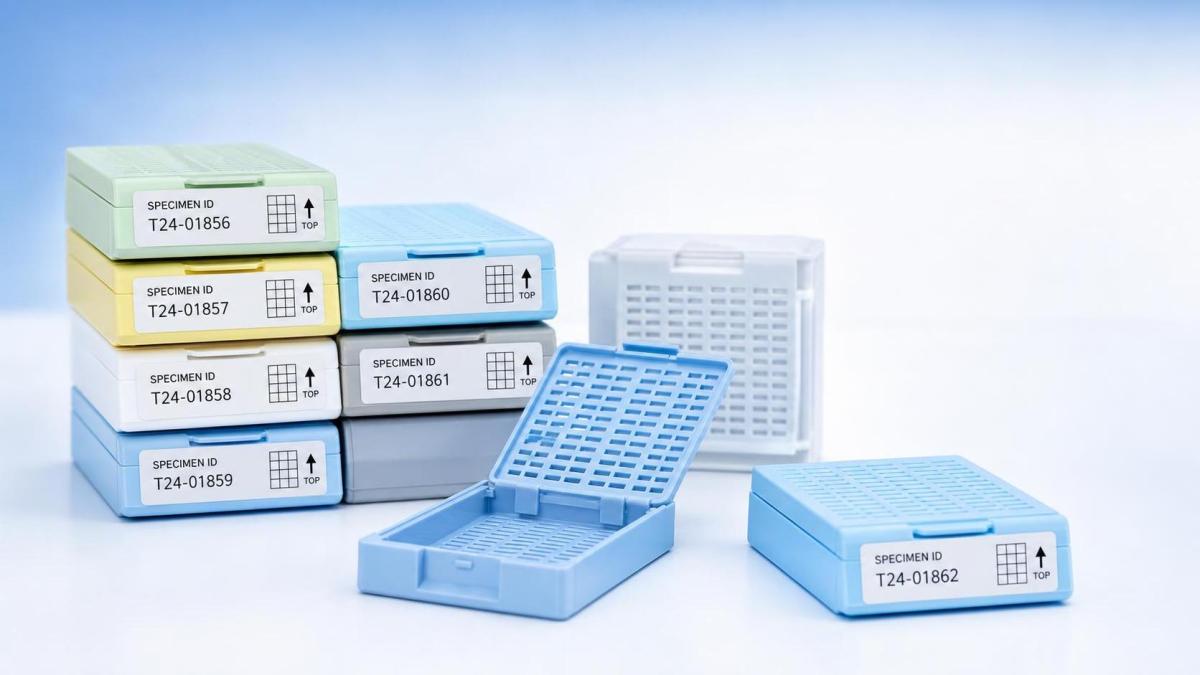
Labeling is not an accessory feature
Many purchasing decisions still focus on plastic quality and overlook print performance. In practice, a cassette is only as reliable as its identification surface. Whether a lab uses laser printing, thermal transfer, or handwriting in limited settings, the marking area needs to stay readable after exposure to common histology reagents and routine handling. Operators should check the actual contrast, not just whether a code can be placed on the face of the cassette.
Angled printing surfaces can improve barcode scanning and manual reading in some workflows, but only if they fit the printer setup already in use. A cassette that prints beautifully on one machine and jams on another is not a better choice; it is a compatibility problem waiting to become a daily nuisance. In high-volume environments, even small printing inconsistencies multiply into wasted time at accessioning, embedding, and slide reconciliation.
This is one of the most common misunderstandings around Embedding Cassette selection: people assume all cassettes with a printable face behave similarly in real use. They do not. Surface finish, molding consistency, and printer matching all affect legibility.
Material behavior under processing conditions
Operators may not need the polymer specification memorized, but they do need confidence that the cassette will maintain shape and closure integrity through routine processing. Histology cassettes are exposed to chemical agents, heat, paraffin, and repeated handling. If the plastic warps, becomes brittle, or the hinge or latch weakens, specimen security and traceability can both suffer.
The right question is less “What material is it made from?” and more “How consistently does this molded part behave through the full process used in our lab?” That includes fixation and processing steps, but also downstream realities such as storage, recuts, and archival handling. Experienced buyers usually ask for sample evaluation because bench performance cannot be judged from appearance alone.
In other sample-handling categories, material transparency may be a practical advantage. For example, Flip-top Sample Cup uses transparent PP to make contents easier to observe during collection and transport. That logic does not transfer directly to embedding cassettes, where observation through the container is usually less important than retention, labeling, and embedding compatibility. It is a good reminder that the “best” sample container depends entirely on where it sits in the workflow.
Fit with operator habits often decides the better option
Two cassette models can look nearly identical and still perform differently once real staff begin using them. Some lids close with a more decisive feel. Some open more predictably during embedding without stressing the hinge. Some stack cleanly, separate cleanly, and move through grossing stations with less hand fatigue. These may sound like secondary concerns, but repetitive handling turns them into meaningful operational differences.
For operators, a practical evaluation often comes down to five checkpoints:
- Can small and delicate tissues be secured without frequent extra wrapping?
- Does the lid lock firmly and reopen in a controlled way?
- Is the printed or written identification still easy to read after processing?
- Does the cassette move smoothly through the lab’s printer and organizing racks?
- Does its shape support consistent tissue orientation at embedding?
If a product performs well on three points but creates doubt on the other two, it is rarely the right long-term choice for a busy lab. Selection should reduce uncertainty, not shift it from one bench to another.
Where low-price decisions usually become expensive
The cheapest cassette may still be acceptable in some stable, lower-complexity settings. But in labs processing mixed specimen types or working under strict turnaround expectations, inconsistency is usually more costly than unit price. A lid that occasionally springs open, a base with irregular molding, or a label area with poor print adhesion can lead to rework that erases any purchasing savings.
This is especially relevant in export supply, where product evaluation often has to consider not only the cassette itself but also batch stability, packaging reliability, and consistency across shipments. Laboratories and distributors usually do not want to requalify a routine consumable every few months because dimensions or molding quality drift. Companies with long-term experience in medical device export tend to see this clearly: stable supply quality is part of product performance, even if it does not appear in a simple specification table.
The same principle explains why reusable or autoclavable features can be valuable in one category and irrelevant in another. A hinged design such as the Flip-top Sample Cup may be useful for one-handed operation when collecting and transporting milk or food samples, but that convenience should not distract buyers evaluating histology cassettes, where closure reliability, chemical exposure, and traceability are the central concerns.
A better way to compare options before purchase
If you are comparing Embedding Cassette options, do not ask only for dimensions and color choices. Ask for a bench trial with your own specimen mix and your own printer. Include difficult samples, not just standard tissue. Let operators who gross, embed, and section evaluate the same cassette, because each stage notices different failure points. Grossing staff may care most about loading and closure. Embedding staff may focus on opening behavior and orientation. Microtomy staff will notice whether the block was set up in a way that made sectioning harder than it needed to be.
A sound selection decision usually comes from this kind of cross-step judgment. The right cassette is the one that keeps tissue secure, identification clear, and handling predictable across the whole chain. That is what better tissue identification and section tracking actually mean in day-to-day histology: fewer assumptions, fewer manual checks, and fewer chances for a small consumable to create a large problem.
Related Posts
Online Message
PROFESSIONAL CONSULTATION
If you are interested in our products and want to know more details, please leave a message here, we will reply you as soon as we can.