


What to check before blaming the microtome
When sections start wrinkling, breaking, compressing, or refusing to ribbon, many operators go straight to blade angle or microtome adjustment. Sometimes that is the problem. Just as often, the tissue embedding wax is setting the whole sectioning run up to fail. Wax controls how well the specimen is supported, how evenly it trims, and how stable the block stays from the first face-off to the last usable section.
In day-to-day histopathology work, the practical questions are straightforward: Is the wax too hard for the tissue type? Too soft for room conditions? Does it infiltrate well enough to support thin sectioning? Is the formulation consistent from batch to batch? If you check those points in the right order, section quality problems become easier to isolate and correct.
Start with the section defect, not the wax label
A common mistake is switching wax grades too early. First look at what the section is actually doing.
- Compression and thick-thin chatter: often linked to insufficient support, incomplete infiltration, or a wax that softens too easily under local room conditions.
- Brittle shattering or edge fragmentation: more likely when the block is too hard, overcooled, or paired with a wax that is not forgiving for dense or delicate tissue.
- Poor ribbon formation: frequently points to wax formulation, static, block temperature, or inconsistent block face texture.
- Holes and tissue drop-out: often suggest infiltration problems before embedding, even when the final block looks acceptable from the outside.
That first read matters. The same tissue embedding wax will behave differently in a warm lab, on fatty tissue, or after suboptimal processing. Diagnose the failure pattern before changing materials.
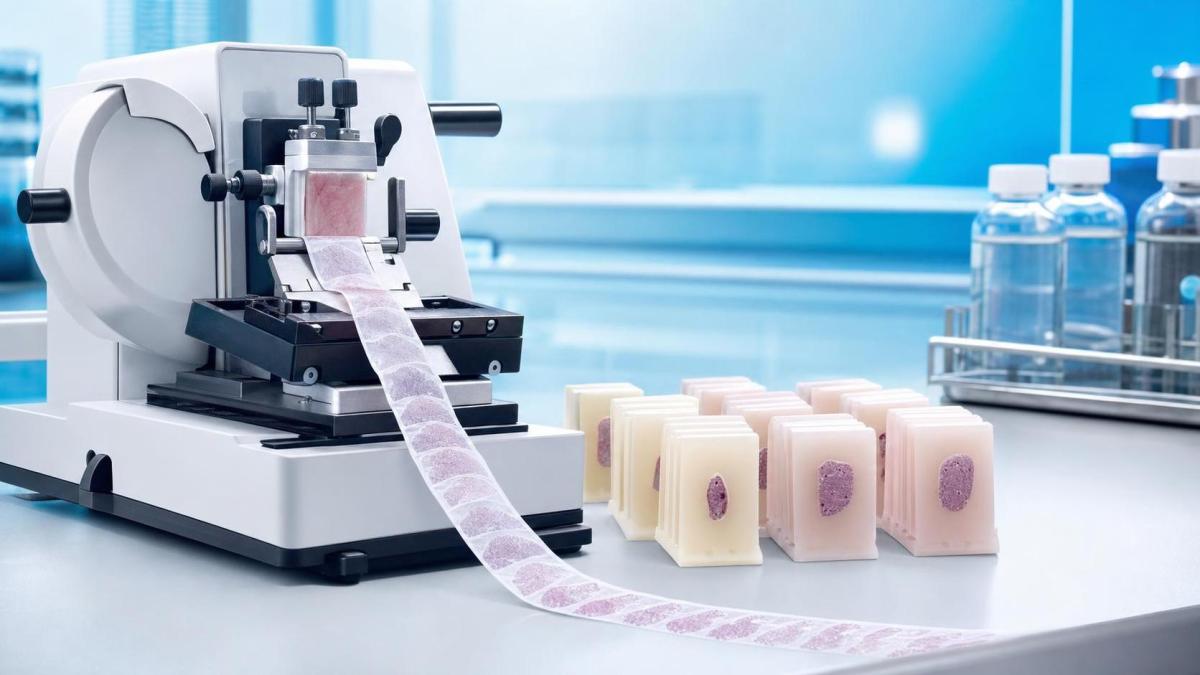
Check hardness against tissue type and room conditions
Hardness is where many sectioning problems begin. Operators usually feel it immediately at trimming: the block either cuts cleanly with steady resistance, or it feels gummy, draggy, or glassy.
As a working rule, softer wax can help with brittle specimens and reduce fracture risk, but it may also increase compression, especially in a warm room. Harder wax improves support and edge definition, but it can punish poorly processed tissue and make section edges chip.
What to check on the bench:
- Whether block faces become tacky during routine handling.
- Whether serial sections compress more as the run continues, which can mean the block is warming too quickly.
- Whether the same wax performs differently across seasons. If winter blocks cut well and summer blocks smear, room temperature is affecting your result more than people think.
If you operate in a lab without tightly controlled ambient temperature, wax selection should reflect that reality. A theoretically suitable formulation can still be the wrong practical choice for your room.
Do not separate melting point from workflow timing
Melting point is often treated like a purchasing spec, but for operators it is really a workflow variable. Higher melting point wax generally offers firmer support during sectioning, yet it also requires careful handling during infiltration and embedding. If the wax solidifies too quickly at the station, orientation becomes harder and interface lines can form around the specimen. If it stays too fluid for too long, the tissue may shift before the block sets.
The practical question is not “high or low melting point?” It is whether the wax remains workable long enough for clean embedding while still delivering a block that holds its shape at cutting temperature.
Look at infiltration quality before judging sectionability
A block can look well embedded and still be poorly infiltrated. That distinction matters. Tissue embedding wax supports the section only when it has actually replaced the clearing agent adequately inside the specimen. If infiltration is incomplete, the center of the tissue behaves differently from the outer edge. That is when you see chatter through one region, tearing in another, or sudden tissue drop-out during flotation.
This is especially worth checking with dense biopsies, fibrous tissue, skin, and larger specimens. Operators sometimes blame the wax when the real cause sits upstream in dehydration, clearing, or paraffin infiltration time. The useful check is comparison: if the same wax cuts cleanly on control tissue processed in a different run, the wax may not be your main problem.
Watch formulation consistency from batch to batch
Even when the specification sheet looks unchanged, performance can drift if batch consistency is weak. Operators notice this first in ribbon behavior and trimming feel. One lot cuts smoothly; the next produces intermittent sticking, uneven ribbons, or a different cooling profile at the embedding center.
A practical receiving check does not need to be elaborate. Keep one reference block type in mind and compare:
- Time to full block set on the cold plate.
- Ease of trimming to full face.
- Ribbon continuity over several consecutive sections.
- How the section spreads on the water bath without overstretching.
If you switch suppliers or lots, this quick comparison gives you something more useful than a general impression.
Do not ignore the cooling step
Good wax can still produce poor blocks if cooling is rushed or uneven. Rapid cooling helps preserve orientation and can improve surface firmness, but excessive chilling may create internal stress, especially in harder formulations. Uneven cooling can also leave one side of the block cutting cleanly while the other side compresses.
If section quality varies within the same block, look at cooling history. Was the mold seated flat? Did the cassette bond evenly to the wax? Was the block cut immediately after cooling without reaching a stable working temperature? Those details matter more than many operators expect.
Match wax choice to the lab’s actual specimen mix
There is no universally “best” tissue embedding wax. A lab cutting mostly small routine biopsies may tolerate a different formulation from one handling fatty tissue, skin, or high-volume mixed specimens all day. Selection should follow the specimen profile you really process, not the broadest product claim on a catalog page.
The same purchasing logic applies across medical consumables. In collection and transport workflows, for example, a kit is only useful if its configuration matches the use setting. A pre-filled system such as 10 in 1 Collection and Transport Kit fits high-volume screening environments like schools, factories, and residences because the package contents and swab options are already aligned with the collection task. Wax selection in histology is similar: the material has to suit the workflow you actually run, not an idealized one.
A short operator checklist that saves time
- Cut one known control block before changing blade angle or replacing equipment settings.
- Compare defect pattern: compression, fracture, chatter, poor ribboning, or tissue loss.
- Check whether the block is warming during handling faster than expected.
- Review whether tissue type matches the hardness behavior of the current wax.
- Look upstream at processing if defects are uneven across the same specimen.
- When evaluating a new lot, compare trimming feel, ribbon formation, and water-bath spread against a familiar reference.
If sectioning quality is inconsistent, work in this order: defect pattern, block temperature, wax behavior, then processing history. That sequence usually gets you to the cause faster than changing several variables at once. Tissue embedding wax affects section quality every day, but its impact becomes manageable when you judge it in the context of tissue type, room conditions, infiltration, and cooling rather than treating it as an isolated product choice.
Related Posts
Online Message
PROFESSIONAL CONSULTATION
If you are interested in our products and want to know more details, please leave a message here, we will reply you as soon as we can.