


What should a distributor look at first when screening a Collection Swab exporter?
Start with the basics that can break a deal later: product scope, export experience, document control, and production consistency. A Collection Swab exporter may look competitive on price, but if the supplier cannot show a stable specification sheet, lot traceability, and clear export documentation, the risk shifts to you.
For an initial screen, ask for the product catalog, intended use description, packaging configuration, shelf life statement if available, and the document set used for export. Then check whether the answers stay consistent across quotation sheets, technical files, labels, and carton marks. Small inconsistencies here often turn into customs delays, registration problems, or complaints from end users.
How do you judge product quality beyond a sample that “looks fine”?
A sample only tells you part of the story. The real question is whether the exporter can deliver the same quality across repeated batches. For collection swabs, that means you should evaluate both the physical product and the quality system behind it.
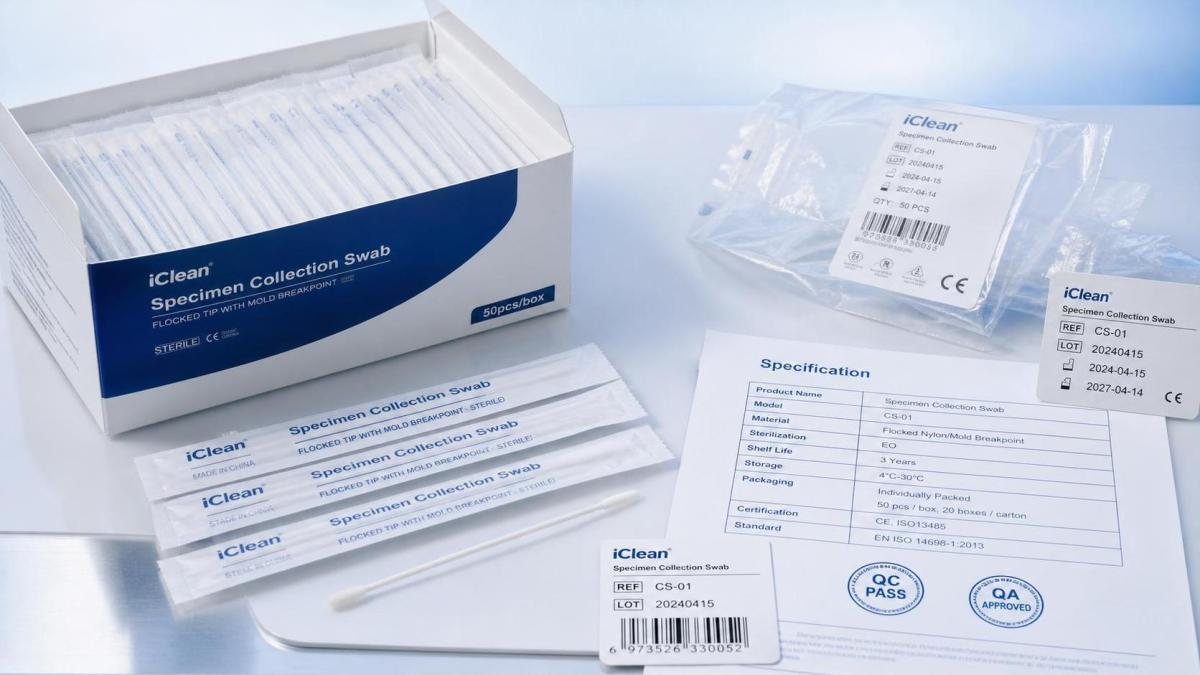
Look at swab head consistency, shaft strength, breakpoint design if applicable, packaging seal integrity, labeling clarity, and batch identification. Then move one step deeper: ask how incoming materials are controlled, how in-process checks are recorded, and how nonconforming lots are handled. A serious exporter can usually explain this clearly without turning the conversation into marketing language.
- Are dimensions and materials defined in a controlled specification?
- Is there a batch or lot number on unit, pouch, inner box, or master carton as relevant?
- Can the supplier provide inspection records for recent production lots?
- Is the packaging suitable for transport conditions in your market?
If the exporter answers with general claims but cannot connect those claims to documents or records, treat that as a warning sign.
Which compliance documents matter most before placing an order?
That depends on your target market and your role in the supply chain, but there are a few document categories that usually matter in every serious review: product specifications, manufacturer information, labeling files, quality management documentation, and export paperwork.
What matters is not just whether the exporter has a certificate on file, but whether the certificate matches the legal manufacturer, the product family, and the documents you will use for import or registration. Distributors often get into trouble when a certificate belongs to one entity, the invoice comes from another, and the label shows a third name.
How can you tell whether the exporter really has enough capacity?
Do not rely on a monthly output number alone. Capacity is only useful if it is available for your order window, your packaging format, and your quality requirements. Ask what portion of the line is reserved for existing customers, what the normal lead time is, and how fast the supplier can scale without changing materials or subcontracting critical steps.
A practical way to test this is to request a phased quotation: trial order, first commercial order, and repeat monthly volume. Then compare lead times, minimum order quantity, and packaging turnaround. If the pricing is attractive but every volume change triggers a new lead time or a different specification, capacity may be less stable than it appears.
This same logic applies across medical consumables. In pathology and histology workflows, for example, buyers reviewing equipment such as Laser Cassette Printer UC-600 8004-0202 also look beyond headline speed. A machine rated at 2.5-4 seconds per cassette and equipped with six loading hoppers sounds efficient, but labs still ask whether it integrates with LIS/HIS systems, fits the actual cassette type in use, and supports day-to-day throughput without workflow disruption. Exporter evaluation works the same way: claimed capacity is only meaningful when it matches the real operating environment.
What pricing questions matter more than the unit price?
Unit price matters, but total landed cost decides whether the deal is workable. Distributors often underestimate the cost impact of packaging changes, labeling revisions, sterilization-related handling where applicable, document preparation, and shipping configuration.
Ask the exporter to break down the commercial offer in a way that lets you compare suppliers fairly. You need to know what changes the price: private label packaging, carton marks, language versions, palletization, sample policy, and order quantity bands. If the supplier cannot explain the cost drivers, margin planning becomes guesswork.
- Quotation term used: EXW, FOB, CIF, or another Incoterm
- MOQ by product code and by packaging format
- Whether mold, artwork, or label changes create extra charges
- Whether documentation fees are built into the price or billed separately
- How long the quoted price stays valid
What are the most common compliance mistakes distributors make with swab sourcing?
The biggest mistake is assuming a product that shipped to one country can automatically ship to another under the same paperwork. Another common problem is approving a sample first and checking labels and technical documents later. By then, commercial momentum is already pushing the deal forward.
The safer order is this:
- Confirm the exact product definition and intended use.
- Review the document set tied to that product code.
- Check label content and shipping marks for your market.
- Approve the commercial sample against the same specification.
- Lock the approved version before mass production.
This sounds simple, but skipping any one of these steps can create relabeling work, rejected goods, or customer complaints that are expensive to unwind.
Should you audit the factory, or is a document review enough?
For low-risk, low-volume trial business, a disciplined document review plus sample evaluation may be enough to start. For long-term distribution, private label programs, or strategic volume, a factory audit is much stronger. You do not need to audit everything at once, but you should inspect the parts that affect repeatability: material control, cleanliness practices, line clearance, labeling control, warehouse segregation, and complaint handling.
If an onsite visit is not practical, request a structured remote audit with live review of production, packaging, storage areas, and record control. A good exporter can support that process in an organized way.
How should an agent compare two exporters that look similar on paper?
Use a weighted comparison instead of a simple price check. Put quality consistency, document accuracy, response speed, lead time stability, and after-sales handling next to price. Then score each supplier against the same questions. This quickly exposes the difference between a supplier that can support a market and one that can only win a quotation.
Pay attention to how the exporter handles detail. When you ask for a revised label file, a batch coding example, or a corrected packing list, do they respond accurately the first time? In medical consumables, execution quality in small things is often the best predictor of what will happen under shipment pressure.
What is a practical final decision rule before signing?
Choose the Collection Swab exporter that can prove three things at the same time: the product stays consistent from batch to batch, the order can be delivered at your required scale, and the paperwork matches the market you are selling into. If one of those three is weak, the low price usually stops looking low once delays, relabeling, claims, or emergency resupply enter the picture.
A sound buying sequence is straightforward: qualify the product, verify the documents, test the supplier with a controlled first order, and only then expand volume. That approach gives distributors and agents a cleaner cost picture and a much better chance of building stable business with fewer surprises.
Related Posts
Online Message
PROFESSIONAL CONSULTATION
If you are interested in our products and want to know more details, please leave a message here, we will reply you as soon as we can.