


Serological Pipettes for Laboratory Use: Key Specs That Affect Accuracy and Safety
When selecting Serological Pipettes for laboratory use, technical evaluators need to pay attention to a point that is often underestimated: a pipette with the right nominal volume can still perform poorly if its graduations, material behavior, sterility condition, or mechanical fit are not aligned with the intended workflow. In routine culture work, reagent preparation, sample transfer, and general liquid handling, small specification differences can change how reliably liquid is measured, how easily the operator reads the scale, and how much contamination risk the process carries.
That is why experienced buyers do not assess these pipettes as simple disposable plastics. They look at them as part of a measurement system: the pipette itself, the pipette aid, the liquid type, the operator’s reading conditions, and the laboratory’s sterility requirements all interact. A technically acceptable product in one environment may be a poor fit in another.
What Accuracy Really Depends On
Graduation quality is the first place to look, but not only in terms of whether markings are present and legible. Evaluators usually care about line consistency, print durability, and how clearly the meniscus can be read against the tube wall. If the plastic is hazy, if the ink smears during handling, or if the scale spacing is visually cramped near the lower volume range, reading error increases even when the underlying molding is acceptable.
Material clarity matters more than many non-users expect. Serological pipettes are often used quickly and repeatedly, sometimes under biosafety cabinet lighting or in crowded bench conditions. A transparent barrel allows the user to confirm aspiration, detect bubbles, and verify whether residual liquid remains on the inner wall. This becomes particularly relevant with protein-containing media or viscous solutions, where liquid behavior is less clean than with water-like fluids.
Another practical factor is whether the pipette is designed and calibrated in a way that matches common laboratory technique. Some users focus only on total capacity, but the more useful question is whether the graduation layout supports the transfer volumes that are actually routine in the lab. If a protocol repeatedly calls for 7 mL, 8.5 mL, or partial dispensing steps, scale readability and interval logic start to matter as much as the maximum volume printed on the barrel.
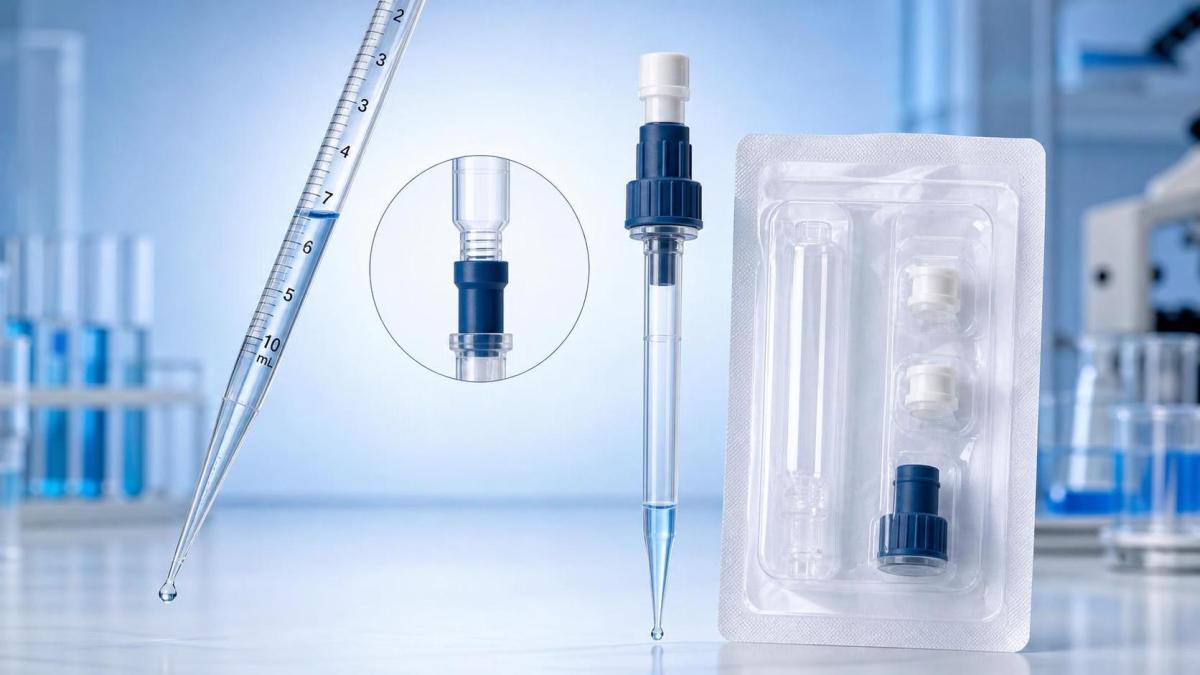
In technical reviews, it is also sensible to distinguish between measurement accuracy and transfer reproducibility. A pipette may be dimensionally acceptable yet still produce inconsistent operator results if the tip shape, internal surface finish, or aspiration response varies from piece to piece. This is why laboratories that run repetitive liquid transfer workflows often prefer products with stable manufacturing consistency over products that simply look comparable on paper.
Safety Is Not Only About Sterility
Sterility is a major procurement criterion for many laboratories, but safety evaluation should go further. Sterile versus non-sterile format depends on the use case. Cell culture, microbiology, and other contamination-sensitive operations generally require sterile, individually wrapped, or otherwise protected presentation. For non-critical liquid transfer, a non-sterile option may be entirely appropriate if the downstream process does not depend on aseptic handling.
The presence of a plug, often made from cotton or a synthetic equivalent, is another specification that affects operator protection and equipment hygiene. In practice, this plug helps reduce the risk of aerosol or over-aspiration entering the pipette aid. That detail matters in busy environments where users work quickly and where liquid carryover into reusable devices creates both maintenance issues and cross-contamination concerns.
Material compatibility also belongs in the safety discussion. Evaluators should confirm whether the pipette material is suitable for the liquids being handled, especially where alcohols, mild solvents, or reagent residues may stress the plastic. Disposable serological pipettes are not universal chemical-transfer tools, and using them outside their normal aqueous or biological handling range can distort both performance and safety expectations.
Fit With Pipette Aids and Manual Accessories
Compatibility with pipette aids is often where procurement issues appear after purchase rather than during evaluation. Even when nominal sizing is standard, insertion force, sealing behavior, and release stability can differ enough to affect usability. A loose fit creates leakage or poor aspiration control. An overly tight fit can slow work and increase the chance of breakage or hand fatigue during repeated changes.
In some settings, manual accessories are still used for simple transfer work. A basic example is the Pipet Bulb, model ML4342-0008, made of natural rubber with a 20 mL capacity. It is intended for liquid sampling, dispensing, and transfer with pipettes. That type of accessory is straightforward, but it still needs dimensional compatibility and predictable elasticity. If suction recovery is inconsistent, volume control becomes more dependent on operator technique than it should be.
This is also where packaging format can matter more than expected. An accessory supplied in practical laboratory quantities, such as 15 pieces per polybag and 300 pieces per carton, may fit distribution and replenishment needs better than a technically equivalent item packed in a way that complicates bench-level use. For export-oriented procurement, these details affect not only storage efficiency but also how consistently products arrive ready for deployment across multiple facilities.
Common Misreadings During Technical Evaluation
One common mistake is to treat all serological pipettes as interchangeable once they share the same volume class. In reality, differences in graduation legibility, plugging design, wall transparency, and pipette-aid fit can produce noticeable variation in daily use. These are not cosmetic differences. They shape error frequency, user confidence, and contamination control.
Another mistake is to evaluate only the product unit and not the use environment. A laboratory working with non-viscous media under standard bench conditions will often judge performance differently from a laboratory handling foaming solutions, biological suspensions, or repetitive aliquoting under sterile constraints. The specification that matters most depends on what failure looks like in that process: wrong volume, slow throughput, contamination, or operator handling difficulty.
A third issue appears in cross-border sourcing. Technical documents may list volume, sterility, and packaging clearly, yet say little about practical reading comfort or fit consistency. Companies with long experience in medical device export usually learn that stable procurement relies on more than catalog comparison. It requires understanding what laboratories and distributors actually reject in use: unclear markings, inconsistent suction behavior, damaged sterile barriers, or accessories that do not seat reliably.
What Deserves a Closer Look Before Approval
For a technical evaluator, that is the useful way to read Serological Pipettes for laboratory use: not as a generic disposable, but as a controlled transfer component with real measurement and biosafety implications. If the review stays focused on actual operating conditions, compatibility with existing devices, and the practical readability and consistency of the product, procurement decisions become more defensible and post-purchase surprises become less common.
In laboratory purchasing, the right question is rarely “What volume do we need?” It is closer to “Under our workflow conditions, which specifications are most likely to prevent avoidable error, contamination, and handling friction?” That shift in perspective usually leads to better product selection than volume and price comparison alone.
Related Posts
Online Message
PROFESSIONAL CONSULTATION
If you are interested in our products and want to know more details, please leave a message here, we will reply you as soon as we can.