


How to verify the issuer of a Maxim green certification claim
A maxim green certification claim on medical consumables may sound reassuring, but who issued it—and what does it actually verify? An environmental claim should never substitute for evidence of product safety or regulatory compliance. Before accepting supplier documentation, check the issuer’s legal identity, the certification criteria, any claimed accreditation, and whether the certificate covers the exact product and manufacturing site under review.
The practical challenge is separating an authentic, relevant assessment from a document that merely looks official. A certificate can be genuine yet cover only packaging, a different factory, or an environmental management system rather than the consumable itself. Verification therefore needs two answers: is the issuer legitimate, and does its assessment support the supplier’s specific claim?
Start with the claim, not the logo
The phrase “Maxim green certification” alone does not establish a recognized standard, certification scheme, or issuing authority. Without the underlying documentation, it should remain an unverified description. Do not infer government recognition, independent testing, or international acceptance from the wording.
Ask the supplier to provide the complete certificate, including annexes, and reproduce the environmental claim exactly as it appears on the label, quotation, or technical file. “Reduced packaging,” “recyclable,” and “environmentally certified” are different assertions requiring different evidence. A broad marketing statement cannot be validated by a narrowly scoped certificate unless the statement is qualified accordingly.
Your initial evidence request should identify:
- The issuer’s full legal name, registered address, and official contact details.
- The scheme owner, published criteria, and applicable revision.
- The certificate number, holder, issue date, expiry date, and current status.
- The covered products, manufacturing locations, and exclusions.
- The basis of assessment, such as an audit, test report, document review, or supplier declaration.
Keep the original files and record when they were received. A cropped image or translated summary is useful for communication, but insufficient for a controlled supplier-approval record.
Trace the issuer through independent records
Separate the organizations involved. The scheme owner defines the rules; the certification body makes certification decisions; a laboratory may perform testing; and the supplier holds or uses the certificate. One organization can perform more than one role, but those roles should be explicit. A laboratory report is not automatically a product certificate.
Search for the issuer’s legal identity through an official business registry where available. Compare its name and address with the certificate and website. Trading names, translations, and subsidiaries can explain differences, but ask for the documented connection rather than assuming similarly named businesses are the same entity.
Find the issuer’s website independently instead of relying exclusively on a supplier-provided link or QR code. A QR code can lead to a convincing page controlled by someone else. Check whether the official site explains the certification service, publishes scheme information, and provides a verifiable contact channel.
Contact the issuer using those independently sourced details. Send the certificate number and copy, then request confirmation of authenticity, current status, holder, scope, and authorized logo use. If there is no public certificate directory, direct written confirmation may still support verification. Conversely, a directory entry alone does not resolve a mismatch in product scope.
Check what any accreditation actually covers
Certification and accreditation are not interchangeable. Certification concerns conformity with specified requirements. Accreditation evaluates a conformity assessment body’s competence for defined activities. A badge stating “accredited” is incomplete without the accrediting body and relevant scope.
If accreditation is claimed, check the accrediting body’s official directory. Match the legal entity, accreditation number, status, and detailed scope. Confirm that the activity supporting the environmental claim falls within that scope; competence in an unrelated service does not validate the claim under review.
Common standards help distinguish the activities:
- ISO/IEC 17065 addresses bodies certifying products, processes, and services.
- ISO/IEC 17021-1 addresses bodies auditing and certifying management systems.
- ISO/IEC 17025 addresses the competence of testing and calibration laboratories.
These standards do not define a “green” medical consumable. They describe requirements for different assessment bodies. Likewise, ISO 14001 certification concerns an environmental management system; it does not, by itself, prove that every product manufactured at a certified site is environmentally preferable.
A private scheme may operate without accreditation. That does not automatically make it fraudulent, but it changes the evidence needed to judge its credibility and whether it meets your tender or purchasing requirements. Record “accreditation not claimed” separately from “claimed accreditation could not be verified.”
Read the environmental criteria behind the certificate
An authentic issuer can still assess criteria that are too narrow for your purpose. Obtain the scheme rules and identify what is measured: material content, restricted substances, manufacturing impacts, packaging reduction, recyclability, or another defined attribute. Look for thresholds, test methods, sampling rules, and a clear assessment boundary.
The ISO 14020 family provides useful distinctions. ISO 14021 addresses self-declared environmental claims; ISO 14024 addresses Type I environmental labelling programmes; and ISO 14025 addresses Type III environmental declarations. These are different approaches, not interchangeable certificates. A quantified environmental declaration is not automatically a declaration that a product is superior to alternatives.
Ask which approach the maxim green certification claim follows, if any. Where no recognized framework is referenced, examine the scheme’s own requirements. Can another competent reviewer understand the assessment and reproduce its reasoning? Are certificate renewal, surveillance, complaints, and suspension addressed?
For medical consumables, disposal conditions deserve particular attention. A material’s recyclability does not mean a used, contaminated item can enter ordinary recycling. Infection-control procedures and local waste rules may limit disposal options. An environmental claim should state the conditions under which it applies rather than imply unrestricted recyclability.
Match the certificate to the item being approved
The evidence chain should run from the claim to the certificate, its annex, the product identifier, and the manufacturing site. If an exporter is the certificate holder but another company manufactures the goods, confirm that this arrangement is permitted and the actual site is covered. Private-label branding needs the same attention.
A useful review sequence is: identify the claim, verify the issuer, confirm certificate status, match scope, and document the decision. A broken connection anywhere in that sequence leaves the claim unresolved.
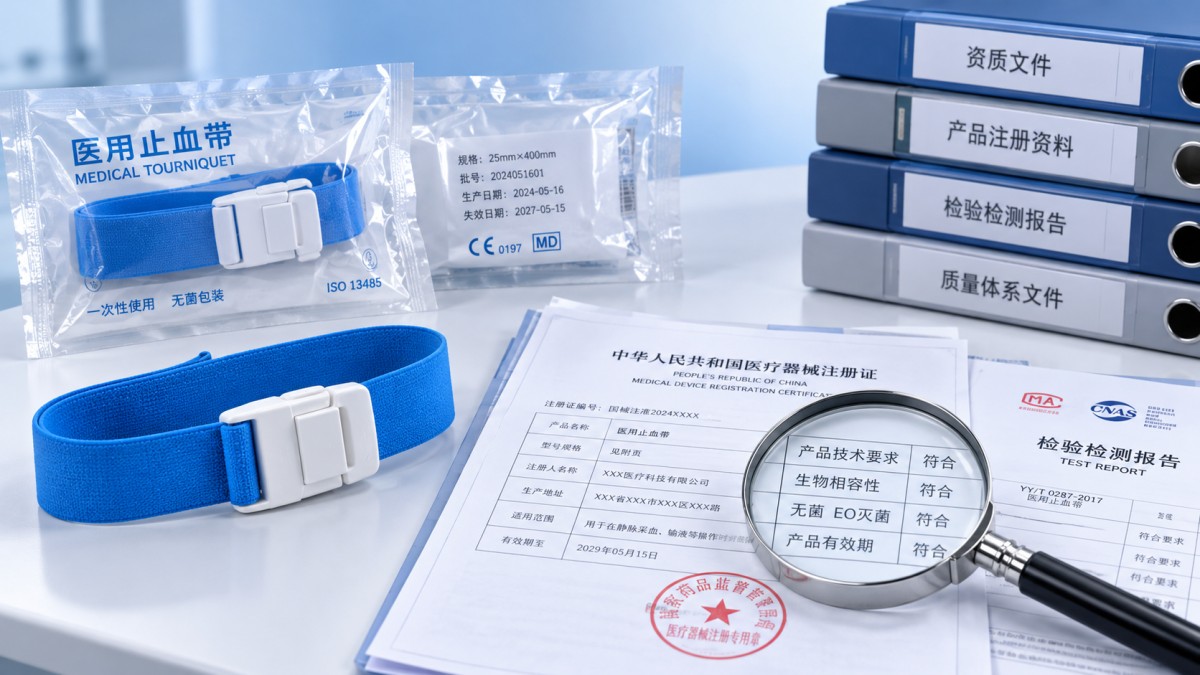
Consider a Tourniquet range listing models ML5870-0001, ML5870-0003, ML5870-0004, ML5870-0002, and ML5870-0005, with dimensions of 450×25 mm and 380×25 mm. A certificate referring only to “elastic medical accessories” may not demonstrate coverage of every listed variant. Request a model-to-scope mapping, especially if materials, components, or manufacturing locations differ.
Packaging also changes the question. For configurations of 1pc/polybag, 50pcs/box, and 300pcs/carton, determine whether the claim concerns the individual bag, outer packaging, or complete packaged product. Evidence about the carton cannot substantiate an environmental statement about the elastic band or buckle. Blue, pink, red, green, and white variants should not be assumed equivalent if the scheme evaluates substances affected by pigments.
The described mechanism—compression through buckles and elastic bands—also makes intended use important. Assisting vein filling during procedures and controlling traumatic hemorrhage require different clinical performance considerations. Neither an environmental certificate nor shared product branding establishes suitability for both applications; check the intended-use documentation and applicable performance evidence separately.
Keep environmental evidence outside the safety approval shortcut
Environmental verification should complement the medical-device review, not replace it. Maintain separate checks for applicable market authorization, intended use, quality-system evidence, material safety, performance, and labelling. Where relevant, sterilization validation and packaging integrity also need their own supporting records.
ISO 13485 certification, for example, concerns a medical-device quality management system; it is not universal product authorization. Similarly, an environmental certificate cannot establish biocompatibility or clinical performance. The required evidence depends on the device, its patient contact, intended use, and destination market.
This distinction becomes critical when a supplier changes materials to support an environmental claim. Recycled content, alternative pigments, or reduced packaging may require assessment of their effects on safety, performance, cleanliness, or shelf life. An environmental improvement does not remove change-control obligations.
Close the review with a defensible decision
Pause acceptance of the claim when the issuer cannot be independently contacted, certificate details conflict with official records, criteria are unavailable, or scope cannot be linked to the supplied product. These are reasons for investigation, not automatic proof of fraud. An expired certificate also needs context: historical certification may be authentic while no longer supporting a current claim.
Record the documents reviewed, verification date, issuer response, applicable criteria, scope limitations, and unresolved questions. Distinguish accepting a limited packaging claim from approving the entire device. If the claim is optional, it may be excluded from approved marketing while the product undergoes its separate safety review. If it is mandatory under the purchasing specification, unresolved evidence should prevent approval against that requirement.
As a medical-device exporter working with institutions, laboratories, and distributors across dozens of countries and regions, we view quality, integrity, and service as practical documentation responsibilities. Useful support means connecting the supplied model and site to verifiable records, explaining limitations, and clarifying destination-market requirements—not forwarding certificates without context.
Before accepting a maxim green certification claim, obtain the issuer’s written confirmation and a clear scope mapping. If either remains missing, describe the claim as unverified. That precise conclusion is more useful than treating a green logo as evidence it was never designed to provide.
Related Posts
Online Message
PROFESSIONAL CONSULTATION
If you are interested in our products and want to know more details, please leave a message here, we will reply you as soon as we can.