


What should procurement teams look at before price in a Maxim Laboratories review?
Start with three things: compliance documents, quality consistency, and supply reliability. Price matters, but in medical consumables, a low unit cost can become expensive very quickly if the shipment is delayed, the documentation is incomplete, or product variation creates trouble in routine use.
That is why a practical maxim laboratories review should begin with evidence, not marketing language. Buyers need to see what documents are available for the specific product, whether the specifications stay consistent from batch to batch, and how the supplier handles repeat orders, packaging, and lead times. Those checks tell you far more about long-term purchasing value than a catalog page does.
Which documents should be reviewed first?
Ask for the product-specific file set before discussing annual volume or rebate terms. Procurement teams often lose time by negotiating price first and discovering later that the paperwork does not match the destination market or intended use.
- Product specification sheet
- Material information where relevant
- Packaging details and labeling format
- Lot or batch traceability information
- Quality management documentation used in export transactions
- Any market-facing compliance documents tied to the target country and product category
The key is not collecting documents for the sake of it. You are checking whether the file set is complete, internally consistent, and matched to the exact item being quoted. A common purchasing mistake is reviewing a generic company document while the actual SKU, packaging unit, or label version is different.
How can you tell if quality is consistent enough for repeat purchasing?
Look for repeatability in the basics: dimensions, finish, material, packaging condition, and compatibility with the user’s workflow. In medical consumables and lab-related products, buyers usually feel quality problems through small inconsistencies rather than dramatic failures. One shipment fits existing practice; the next one slows work down or causes handling issues.
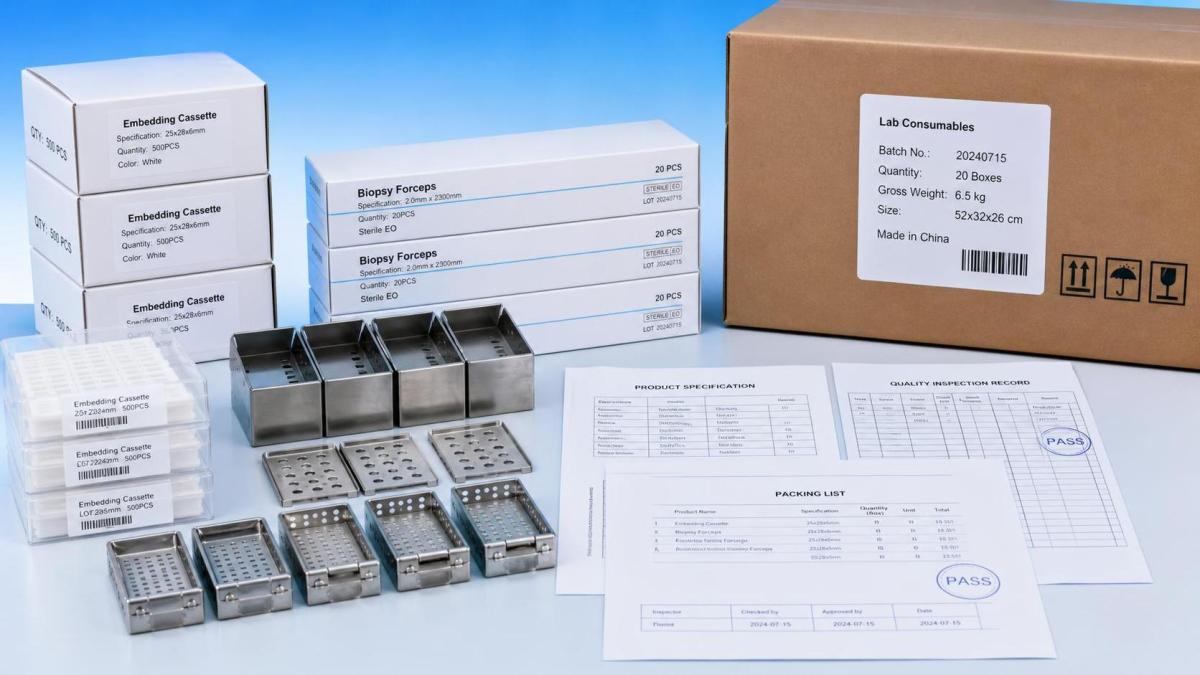
A useful review method is to compare three layers at once: the specification sheet, the sample, and the quotation. If those three do not align, treat that as an early warning sign. Procurement teams should also check whether the supplier uses stable item coding and whether packaging labels make batch tracking straightforward after goods arrive.
What supply chain questions matter more than buyers usually expect?
Lead time is only one part of supply reliability. You also need to know how the supplier handles raw material availability, production scheduling, packing accuracy, and reorder stability. A quote that looks attractive on paper may still be risky if replenishment depends on unstable sourcing or if delivery timing changes from order to order.
Ask direct operational questions:
- Is the quoted lead time for samples, first order, or repeat order?
- Does the packing method stay the same across shipments?
- Can the supplier support multiple models in one order without increasing error risk?
- What information appears on cartons and inner labels for receiving control?
These are practical purchasing questions. They affect warehouse receiving, internal inspection time, and emergency replenishment costs.
Is a low quote from maxim laboratories always a good sign?
Not by itself. In procurement, the right question is total acquisition cost, not just unit price. A lower quote can still cost more if it creates extra incoming inspection work, higher rejection rates, repacking labor, or urgent replacement orders.
When comparing offers, normalize the quote first. Make sure the model, packing unit, surface finish, material, and shipment terms are aligned before calling one supplier cheaper.
What product details deserve closer review for pathology and lab accessories?
This is where buyers can avoid many routine problems. For tissue processing and embedding accessories, dimensional accuracy and equipment compatibility are not minor details. They affect workflow speed and fit with the lab’s existing consumables and instruments.
For example, if you are reviewing items such as Stainless Base Mold, the useful checks are straightforward: confirm the available sizes, confirm that the material is stainless steel, and verify whether the polished reusable design matches your lab’s handling practice. The listed size options include 7X7X7MM, 15X15X7MM, 24X24X7MM, 37X24X7MM, and 30X24X7MM. Those details matter because the wrong size or mismatch with cassette style can create immediate operational friction.
You should also review whether the item is described as compatible with commonly used embedding equipment and whether its intended function fits your application, such as supporting same-style cassettes or specimen embedding steps. That is a better procurement check than asking only whether the product is “high quality.”
When should a buyer request samples, and what should the sample prove?
Request samples when the product interacts with an existing workflow, instrument, or standardized internal procedure. The sample should prove more than appearance. It should confirm handling, fit, finish, packaging condition on arrival, and whether the delivered item matches the quoted specification exactly.
A sample review is especially useful when multiple models are available. With lab accessories, even small dimensional differences can change usability. Procurement should involve the end user early enough to capture feedback before order release, not after goods are already in transit.
What are the most common mistakes in a Maxim Laboratories review?
One is treating all medical consumables as interchangeable once the broad category looks similar. Another is approving a supplier based on catalog breadth without checking whether the exact model, finish, and packaging format required by the user are stable and available.
Other common errors include:
- Comparing quotes with different pack assumptions
- Skipping end-user evaluation for workflow-sensitive items
- Accepting generic documents that are not tied to the actual product code
- Ignoring reorder performance and focusing only on the first shipment
Most purchasing headaches come from those small gaps between what was quoted, what was approved, and what was finally delivered.
What is the best way to make the final sourcing decision?
Use a short decision sequence. First, confirm the exact product identity and intended use. Next, review documents tied to that item. Then test sample suitability where workflow fit matters. After that, compare total procurement cost, including handling and replenishment risk. Only then does price ranking become meaningful.
For procurement teams reviewing maxim laboratories, the practical rule is simple: if a supplier can clearly support compliant documentation, stable specifications, and dependable repeat supply, the quote deserves serious attention. If those three areas are vague, the lower price is usually not the cheaper option in real operation.
Related Posts
Online Message
PROFESSIONAL CONSULTATION
If you are interested in our products and want to know more details, please leave a message here, we will reply you as soon as we can.