


What matters most before you compare price?
When buyers look at maxim biomedical inc, the first mistake is treating the quotation sheet as the whole story. In medical consumables, low unit cost means very little if the supplier cannot support the regulatory, quality, and logistics requirements tied to your target market. A business evaluator usually needs to answer a simpler question first: can this supplier consistently deliver compliant product, in the right format, with acceptable documentation and lead time?
That is the right starting point. Product range and pricing matter, but they should come after supplier verification, not before it.
Which documents should a buyer request at the early evaluation stage?
Ask for the documents that tell you whether the supplier can legally export and whether the product can move through your own import and distribution process without friction. For maxim biomedical inc, that means checking company-level and product-level paperwork separately.
- Company registration and exporter information
- Quality system documentation relevant to the product category
- Product specifications and packaging details
- Applicable test reports or declarations supplied for the item
- Shipping documents and labeling samples for market review
The practical check is not just whether documents exist. Review whether names, model numbers, packaging descriptions, and manufacturer details match across files. Many procurement delays come from inconsistent product descriptions between quotation, label artwork, invoice, and compliance documents.
How do you evaluate compliance without assuming every market works the same way?
This is where commercial teams often lose time. There is no single global compliance shortcut. What you need to verify depends on four variables: product classification, intended use, destination country, and your role in the supply chain.
For example, a distributor importing into one market may need a different documentation set than a laboratory buyer purchasing for direct internal use in another. So instead of asking a broad question like “Is the product certified?”, ask a narrower one: which documents support import, customs clearance, local registration, or tender submission in the target market?
That approach gives you something usable. You are checking fit for your transaction, not collecting generic supplier claims.
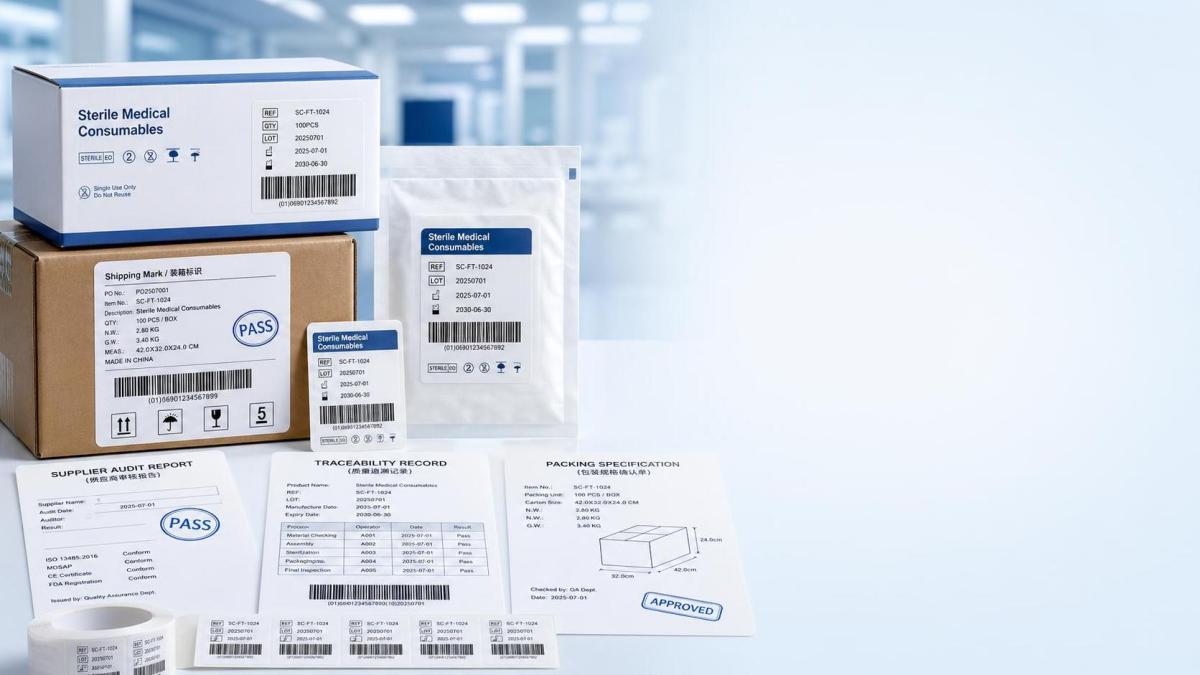
What should you look for in quality control, beyond a polished brochure?
A good supplier conversation becomes concrete very quickly. Ask how incoming materials are controlled, how production lots are identified, and how nonconforming product is handled. If the answers stay vague, that is already useful information.
You want to understand whether the company can trace a shipment back to a specific production lot and whether it can isolate a problem without disrupting every open order. In medical consumables, traceability is not just a quality topic. It affects recall exposure, complaint handling, and distributor liability.
Another point buyers miss: packaging control. If carton counts, inner bag quantities, or label formats change without clear notice, your warehouse and sales channels feel the impact immediately.
How can you test whether supply stability is real?
Do not rely on a verbal promise that capacity is “stable.” Ask operational questions that expose how the supplier actually runs.
If the supplier handles multiple markets, ask how peak demand periods affect export scheduling. A supplier can be legitimate and still be a poor fit for your timeline if allocation discipline is weak.
What pricing questions reveal the real landed cost?
The useful question is not “Can you lower the price?” It is “What will this product cost after packaging, documentation, freight, customs handling, and possible relabeling are included?”
When evaluating maxim biomedical inc, compare offers on the same commercial basis. Check unit pricing against:
- Incoterm used in the quotation
- Inner pack and carton quantity
- Whether labels, manuals, or language changes create extra cost
- Sample charges and sample freight
- Payment terms and their effect on financing cost
A cheaper unit packed inefficiently can become more expensive once shipping and storage are calculated. That is especially true for bulky but lightweight consumables.
Can a product sample tell you enough to make a sourcing decision?
A sample is useful, but only if you evaluate it against the same conditions that will matter in procurement. Physical inspection alone is too narrow. Match the sample to its model number, packing format, and declared use. Then compare that with the commercial documents you received.
Take a simple lab item as an example. If you are reviewing Long Stem Funnel for analytical techniques, the practical questions are straightforward: does the model supplied match the quoted reference, does it work with standard filter papers, is the 60° angle suitable for your workflow, and are the packing options aligned with your inventory plan? Product details such as good chemical resistance, durability, autoclavable construction, and external ribbing to reduce air lock are relevant only if they solve a real use-case in your operation.
That is how samples support procurement. They should confirm fitness, not just create a favorable first impression.
What are the common red flags during supplier review?
A few warning signs show up repeatedly in medical sourcing:
- Model numbers differ between quote, label, and shipping draft
- Packaging quantities are unclear or keep changing
- Technical descriptions sound broad but do not map to a specific item
- Response time is fast on sales topics but slow on document questions
- Complaint handling process is described vaguely
None of these automatically rules out a supplier. But together they suggest that internal control may be weaker than the sales presentation suggests.
How much weight should after-sales support carry in the decision?
More than many procurement teams give it. In practice, after-sales support is where supplier quality becomes visible. If there is a packing discrepancy, transit damage issue, or lot-related complaint, you need a clear path for response: who receives the claim, what evidence is required, and how replacement or corrective action is handled.
This matters even more for cross-border orders, where small disputes can stall future shipments. A supplier that responds with structured documentation and a defined process is easier to work with than one that treats every problem as a one-off negotiation.
What is the best way to make a final sourcing call?
Use a simple decision rule: approve the supplier only when documents, product fit, logistics, and total cost all align on the same item and the same order scenario. That sounds obvious, but many failed sourcing decisions come from evaluating each part separately and assuming they will connect later.
For maxim biomedical inc, the strongest evaluation is not built on one attractive quote or one acceptable sample. It comes from consistency across paperwork, specifications, packaging, communication, and delivery terms. If those pieces line up cleanly, you are looking at a supplier worth moving forward with.
Related Posts
Online Message
PROFESSIONAL CONSULTATION
If you are interested in our products and want to know more details, please leave a message here, we will reply you as soon as we can.