


Heparin blood collection tubes intended to contain and preserve human specimens for in vitro diagnostic examination generally fall under the EU In Vitro Diagnostic Medical Devices Regulation, Regulation (EU) 2017/746 (IVDR). The essential compliance package is not simply a CE certificate: it includes an EU Declaration of Conformity, applicable notified body certification, compliant labeling and instructions, and records that connect the supplied tubes to the manufacturer and production lot.
Not every document must physically accompany every shipment. Labels and required user information must accompany the device, while declarations, certificates and supporting quality records must be available through the appropriate compliance and supply-chain arrangements. Shipment acceptance should distinguish legal documentation requirements from additional evidence needed to control specimen integrity, sterility and traceability.
Establish the regulatory route before checking certificates
A routine heparin tube whose intended purpose is the primary containment and preservation of a blood specimen for diagnostic examination is a specimen receptacle under the IVDR. Under Annex VIII, Rule 5, specimen receptacles are Class A. The presence of lithium or sodium heparin does not, by itself, make the tube a higher-class device.
Sterile status changes the conformity assessment route. For a Class A tube placed on the market in a sterile condition, a notified body must be involved in the aspects concerned with establishing, securing and maintaining sterility. For a non-sterile Class A tube, IVDR conformity assessment does not require notified body involvement.
This distinction prevents two common errors: rejecting a legitimate non-sterile Class A tube because it has no notified body certificate, or accepting a sterile tube on the strength of a manufacturer’s declaration alone. Classification must be supported by the stated intended purpose, not inferred only from a product photograph or catalog category.
Other components in a blood collection system can follow different regulatory routes. A needle used to enter the patient is not automatically covered by the tube’s IVDR documentation. Likewise, a tube claimed for a therapeutic rather than diagnostic purpose requires a separate regulatory assessment. A combined commercial package should identify which documentation covers each component.
The EU Declaration of Conformity must identify the supplied device
The EU Declaration of Conformity is the manufacturer’s legally accountable statement that the device complies with the applicable requirements. For an IVDR device, its content is governed by Annex IV. Request the controlled declaration covering the actual product family and supplied references, rather than a generic statement that the manufacturer’s products are “CE approved.”
The declaration should identify:
- The manufacturer and, where applicable, its EU authorized representative, with the required identifying details.
- The device, its intended purpose and sufficient product identification to establish what the declaration covers.
- The Basic UDI-DI, where applicable under the relevant regulatory route.
- The risk class and the applicable EU legislation.
- The notified body, certificate information and conformity assessment procedure, where notified body involvement is required.
- The place and date of issue, authorized signatory and statement of the manufacturer’s responsibility.
A declaration may cover a family of tubes rather than list every reference in its main text. In that case, an annex or controlled product list should make the connection unambiguous. Lithium heparin, sodium heparin, gel-separator and different draw-volume variants should not be treated as interchangeable merely because they share a cap color.
Check whether the declaration cites the IVDR or the former In Vitro Diagnostic Medical Devices Directive, Directive 98/79/EC (IVDD). An IVDD declaration is not automatically invalid, because qualifying legacy devices may remain eligible for transitional arrangements. However, it requires a different evidence review; it cannot be accepted as if it were an IVDR declaration.
For sterile tubes, verify the notified body’s scope—not just its logo
A sterile Class A tube following the IVDR route should have the relevant notified body certificate supporting its conformity assessment. The certificate may cover a defined product group or quality system scope rather than name every tube reference. The manufacturer should provide a clear mapping between the certificate scope and the supplied product.
Review the legal manufacturer’s name, manufacturing locations where relevant, certificate number, scope, issue and expiry information, and any restrictions. A certificate for another company in the same corporate group is not sufficient without a documented explanation of the legal and manufacturing relationship.
The notified body’s identification number should correspond to the number accompanying the CE marking where its involvement applies. Use the European Commission’s NANDO information to check the body’s designation under the relevant legislation and scope. NANDO establishes designation; it does not authenticate every certificate issued in that body’s name. Where authenticity is uncertain, use the issuing body’s verification service or contact it directly.
An ISO 13485 quality management system certificate is useful supporting evidence, but it does not replace the IVDR Declaration of Conformity or applicable notified body certification. Similarly, a free sale certificate, export certificate or distributor authorization letter does not establish EU conformity by itself.
Legacy IVDD documentation needs a separate acceptance decision
The IVDR’s amended transitional provisions allow certain qualifying legacy devices to continue being placed on the market subject to specific conditions. These arrangements are not a blanket extension for every product bearing an old CE mark.
A sterile Class A specimen receptacle that previously relied on IVDD self-declaration may be relevant to these provisions because the IVDR introduces notified body involvement for sterility. By contrast, a non-sterile Class A device cannot rely on that same rationale merely to postpone IVDR compliance.
For a legacy tube, request the historical declaration and any applicable historical certificate, together with evidence supporting the claimed transitional eligibility. Relevant evidence includes the device’s status before the IVDR date of application, absence of significant changes in design or intended purpose, and fulfillment of the applicable quality-system and notified body application or agreement milestones.
The applicable placing-on-the-market deadline and conditions should be checked against the current consolidated text of Article 110. A supplier statement saying “the EU extended all certificates” is inadequate, particularly where the product’s former conformity route did not involve a certificate.
Labels and instructions must agree with the declaration
Review actual artwork for the tube, sales packaging and transport packaging—not only a catalog image. Different packaging levels carry different information, so an omission on the individual tube is not necessarily a defect if the IVDR permits that information elsewhere. The complete labeling arrangement must still satisfy Annex I, Chapter III.
The review should cover device identification, manufacturer details, authorized representative information where required, CE marking, applicable notified body number, lot identification, expiry information, storage conditions and sterile-status information. The heparin type and nominal draw volume must be clear enough to support correct selection and use.
For devices following the IVDR route, check UDI requirements at the relevant packaging levels and applicable implementation dates. The Basic UDI-DI is a regulatory identifier used in documentation; it is not the same as the UDI carrier printed on packaging. Legacy devices require assessment under their applicable identification arrangements rather than an assumption that every IVDR labeling rule applies identically.
Required information must be provided in the language or languages accepted by the destination Member State. An English-only pack is not automatically suitable throughout the EU.
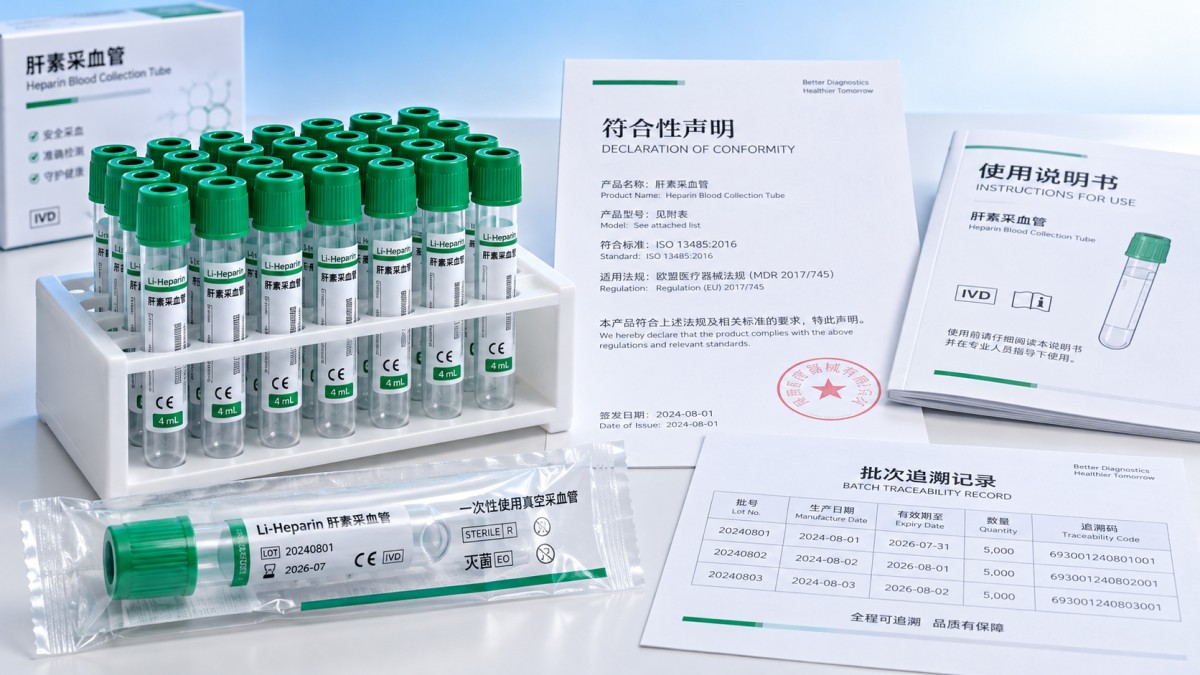
Instructions should support the tube’s actual workflow: filling, mixing, centrifugation where applicable, storage, specimen handling and limitations. Under the IVDR, instructions for use may be omitted for Class A and Class B devices if they can be used safely without them, unless otherwise required. That exception should be justified; it should not become a reason to withhold essential handling information.
Electronic instructions also require a valid basis under the applicable rules. A QR code linking to an uncontrolled webpage is not, by itself, evidence that the required user information has been supplied correctly.
Request technical evidence that addresses specimen and sterility risks
The full technical documentation is maintained by the manufacturer and is not normally a document set delivered with every carton. Nevertheless, qualification of a Heparin Tube Europe supplier should include access to appropriate summaries or reports demonstrating the claims on which acceptance depends.
For tube performance, relevant evidence can include draw-volume accuracy, additive quantity and distribution, leakage resistance, closure performance and suitability for the claimed specimen-processing conditions. EN ISO 6710, concerning single-use containers for human venous blood specimen collection, is a relevant standard to assess where applicable. Standards support conformity assessment; citing one does not establish compliance with every IVDR requirement.
Heparin type matters clinically. Lithium heparin tubes are not appropriate for measuring lithium, and sodium heparin can affect sodium measurement. Fill volume also affects the additive-to-blood relationship. Documentation should support the stated applications and restrictions rather than claim universal analyzer compatibility without evidence.
For sterile tubes, request evidence appropriate to the sterilization method and sterile barrier system. Relevant standards can include the ISO 11135 series for ethylene oxide processes, ISO 11137 for radiation sterilization, and ISO 11607 for packaging of terminally sterilized medical devices. The applicable editions, scope and regulatory status should be identified by the manufacturer.
A batch sterility test is not a substitute for validated sterilization and process control. Likewise, a shelf-life claim requires evidence that packaging integrity and relevant tube performance remain acceptable through the claimed storage period. For evacuated tubes, loss of vacuum can compromise draw volume even when the packaging appears intact.
Separate shipment records from the regulatory qualification file
A practical acceptance system keeps stable regulatory documents in a controlled supplier file and links each delivery to batch-specific records. This avoids demanding a complete technical dossier with every shipment while still preserving the evidence needed to investigate defects.
A certificate of analysis is not a universal IVDR document required to accompany every tube shipment. Its value depends on the agreed tests and release criteria. A sheet marked only “passed” provides little assurance if it does not identify the lot, specifications or basis of release.
For manufacturers outside the EU, verify the authorized representative and identify the EU importer. The importer has its own IVDR verification and identification obligations. Customs clearance, commercial invoices and transport documents cannot substitute for those checks.
Hold acceptance when the evidence cannot be reconciled
Unexplained differences between the manufacturer named on the declaration, certificate and label warrant a hold. So do missing coverage for the ordered variant, unsupported sterile claims, inconsistent notified body numbers, expired documentation without a substantiated legal basis, and lot numbers that cannot be connected to release records.
The appropriate response depends on the defect. A missing controlled annex may be resolved by obtaining it; an unsupported conformity route requires a regulatory reassessment. A damaged sterile barrier or unreadable lot identifier is a product acceptance issue even when the manufacturer’s certificates are valid.
The decisive question is whether the documents form a consistent chain: intended purpose, regulatory classification, conformity assessment, labeling, validated performance and released lot. That chain—not the number of certificates in a supplier’s folder—determines whether the delivered heparin tubes have an adequately supported basis for acceptance.
Primary legal references: Regulation (EU) 2017/746, particularly Articles 10, 13, 17, 48 and 110, and Annexes I, IV and VIII; and Regulation (EU) 2024/1860, which amended relevant transitional provisions.
Related Posts
Online Message
PROFESSIONAL CONSULTATION
If you are interested in our products and want to know more details, please leave a message here, we will reply you as soon as we can.