


Choosing the right histowax melting point means balancing processing compatibility, tissue preservation, and sectioning performance. The hardest wax is not automatically the best option.
For technical evaluators, the strongest starting point is a documented melting range that fits the laboratory’s validated processing conditions, tissue mix, and routine sectioning environment.
Excessive heat exposure can compromise tissue quality, while an unsuitable formulation may contribute to compression or inconsistent sections. Melting point alone cannot predict these outcomes.
This guide explains how to assess wax specifications, compare candidate products, and establish practical acceptance criteria before introducing a new embedding material into routine histology.
What does the melting range actually tell you?
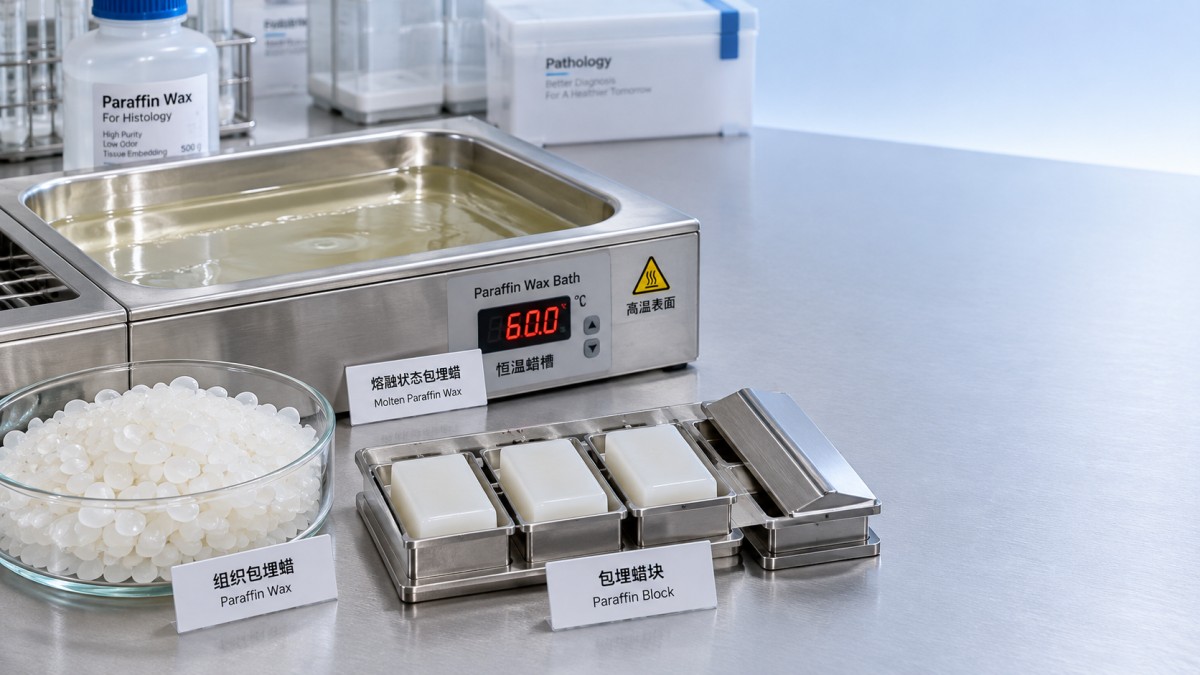
A histowax melting specification describes its thermal transition under a stated test method. It does not independently establish infiltration quality, block hardness, or sectioning reliability.
Commercial embedding waxes contain paraffin with formulation differences that may include polymers or other modifiers. These differences influence handling even when nominal melting ranges overlap.
Two products labeled with the same melting range can therefore behave differently during ribbon formation, cooling, trimming, and cutting. Compare formulation information alongside temperature specifications.
Ask whether the supplier reports a melting range, a single melting point, or a congealing point. These measurements describe related properties but are not interchangeable.
A range such as 56–58°C may appear in a supplier specification, but it is an example, not a universal recommendation for every tissue or laboratory.
The useful question is whether that documented range supports complete melting and satisfactory infiltration within your established equipment settings, exposure times, and diagnostic quality requirements.
Which laboratory conditions should determine your shortlist?
Begin with your current tissue processor settings, embedding station configuration, room temperature, cooling practices, and typical section thickness. These conditions define the practical operating requirements.
Record the tissue types processed most frequently, including small biopsies, fatty specimens, dense fibrous tissue, and larger resections. Identify specimens already associated with recurring difficulties.
Also document fixation, dehydration, clearing reagents, and reagent maintenance schedules. Wax performance cannot compensate reliably for incomplete upstream processing or unsuitable specimen thickness during infiltration.
If your laboratory already produces acceptable blocks, treat the incumbent wax as the reference. A replacement should demonstrate comparable performance under the existing validated workflow.
Where a change is intended to correct a problem, define that problem precisely. Compression, incomplete infiltration, and brittle sections require different investigations and acceptance criteria.
Shortlist products with compatible instructions and adequate technical documentation. Avoid choosing a melting range solely because another laboratory reports success under substantially different operating conditions.
How should you compare lower and higher melting ranges?
Within otherwise comparable formulations, a higher melting range may accompany greater firmness at a given temperature. However, additives can substantially change that relationship in practice.
A lower melting range may permit lower working temperatures when supported by the manufacturer’s instructions. It may also provide insufficient support under warmer cutting conditions.
Higher melting wax may help maintain block firmness in some laboratories, but its thermal requirements must remain compatible with specimen preservation and the validated processing method.
Use the following comparison as a starting framework. Each tendency requires confirmation using the actual product, representative tissues, and the laboratory’s intended operating conditions.
Do not assume that a narrow published melting range proves superior consistency. Its value depends on the measurement method, manufacturing controls, and actual lot performance.
How much heat is appropriate during infiltration and embedding?
Follow the wax manufacturer’s recommended working temperatures and your laboratory’s validated protocol. The published melting range is not, by itself, an instruction for setting equipment.
Some workflows use temperatures modestly above the melting range to maintain fluidity. The appropriate margin depends on formulation, equipment, and the requirements of the protocol.
Verify actual wax temperatures using a suitable calibrated device. Displayed setpoints may differ from measured temperatures, particularly across reservoirs, heated surfaces, or different equipment locations.
Keep infiltration temperature and duration under review together. Increasing heat to compensate for incomplete processing can introduce additional damage without resolving the underlying preparation problem.
Prolonged excessive heating can adversely affect morphology and some downstream analytical targets. The significance depends on the specimen, assay, and cumulative processing conditions in use.
During embedding, maintain adequate fluidity for orientation and uniform filling. Check heated forceps, molds, and holding areas because localized overheating can escape routine reservoir checks.
How should tissue type influence the decision?
Small biopsies need reliable orientation and support without unnecessary thermal exposure. Evaluate whether candidate waxes preserve tissue integrity during trimming and yield complete sections consistently.
Fatty specimens present processing challenges that should be addressed through validated dehydration, clearing, and infiltration. A harder wax does not automatically correct residual fat or moisture.
Dense fibrous tissues may test cutting support, but blade condition, clearance angle, and processing quality also matter. Assess these factors before attributing problems to melting point.
For heterogeneous specimens, inspect interfaces between tissue components. Tearing, gaps, or uneven support can reveal processing or embedding deficiencies that average section quality may conceal.
Include relevant downstream work in the comparison, such as routine staining, immunohistochemistry, or molecular testing. Compatibility claims should reflect evidence appropriate to the intended application.
If different specimen groups need different waxes, assess the operational consequences. Additional inventories and handling rules should deliver a demonstrable benefit that justifies increased complexity.
What sectioning problems genuinely indicate a wax mismatch?
Compression can indicate that the block is too warm or insufficiently supported. It can also arise from a dull blade, cutting speed, or microtome setup.
Chatter may involve excessive hardness, brittle tissue, mechanical instability, or an unsuitable clearance angle. Switching to a lower melting wax without investigation may miss the cause.
Poor ribbon formation can reflect formulation, block temperature, blade condition, or block geometry. Document when the problem occurs and whether it affects all tissue types.
Cracking and separation between tissue and wax warrant checking processing completeness and cooling conditions. These defects do not provide a dependable diagnosis of melting point mismatch.
Use consistent block cooling and standardized cutting conditions when comparing products. Uncontrolled differences in handling can make one candidate appear better without demonstrating a material advantage.
Record recuts, lost tissue, usable sections, and operator observations. These practical outcomes reveal whether a wax improves routine work more clearly than subjective hardness alone.
How can you run a useful comparison before purchasing?
Use representative noncritical specimens or suitable retained material according to laboratory policy. Include routine tissues and known difficult cases instead of selecting only easy specimens.
Compare candidate histowax against the reference product using matched conditions wherever practical. Record tissue dimensions, processing schedules, measured temperatures, cooling methods, and microtome settings consistently.
For compatible products, an initial comparison under existing validated settings can reveal replacement suitability. Where instructions require different conditions, evaluate those conditions as a separate workflow.
Agree on acceptance criteria before the trial begins. Define acceptable morphology, infiltration, section completeness, ribbon formation, staining performance, and any relevant downstream analytical results beforehand.
Include more than one operator when practical, and assess sections without revealing the wax identity. This reduces preference bias while exposing differences in handling sensitivity.
Measure operational consequences alongside technical quality: recut frequency, trimming loss, processing interruptions, and time required to obtain acceptable slides. Lower purchase prices may conceal higher costs.
Record product identity, lot numbers, dates, and deviations. A successful trial should produce traceable evidence that supports approval, staff instructions, and subsequent investigation of performance changes.
Which supplier documents and purchasing details matter most?
Request the technical data sheet, safety data sheet, instructions for use, and relevant lot documentation. Confirm that product identifiers match the material offered for purchase.
Check the stated melting specification, measurement method where available, recommended operating temperatures, storage conditions, and shelf life. Clarify ambiguous terminology before approving the product technically.
Ask about formulation changes and notification procedures. A familiar product name does not guarantee that composition, manufacturing location, or handling characteristics will remain unchanged indefinitely.
For international procurement, assess packaging integrity, traceability, delivery reliability, and access to technical support. Quality records and responsive service matter when troubleshooting across different markets.
Confirm applicable local requirements and the product’s stated intended use. Broad marketing descriptions cannot substitute for documentation supporting the application your laboratory plans to perform.
Related laboratory purchases should remain application-specific. The Evaporating Dish is a porcelain vessel with a pouring spout and glazed interior, offered in capacities from 15–3000 mL.
Its stated heat resistance reaches 1050°C, with high chemical resistance. These specifications concern separate evaporation applications; they do not establish compatibility with tissue processing or embedding.
What should your final selection decision look like?
Choose the histowax melting range that delivers acceptable infiltration and section quality within documented, validated operating conditions. Treat formulation and thermal requirements as interconnected selection factors.
Approve a candidate when representative specimens meet predefined criteria, relevant downstream tests remain acceptable, and operators can reproduce the results without excessive adjustments or additional handling.
Document the approved product, working temperatures, storage requirements, and performance checks. Establish proportionate incoming checks and reassessment triggers for supplier changes or recurring sectioning defects.
The best choice is supported by evidence from your workflow. A suitable melting specification enables reliable work; it cannot replace controlled processing and verified section quality.