


Borosilicate test tubes crack during heating when temperature differences create more stress than the glass can withstand. Concentrated heat, sudden cooling, scratches, and chipped rims are common triggers. A tube can also fail because it is clamped too tightly, heated with a sealed opening, or used outside its specified heating conditions. Heat resistance reduces susceptibility to thermal shock; it does not make damaged glass or unsuitable heating arrangements safe.
The timing of the break provides a useful starting point. A fracture while entering a hot bath suggests a rapid temperature change. Failure beneath a stationary flame points toward localized heating. Cracking after removal from heat directs attention to the cooling surface, nearby water, or handling damage. These patterns guide investigation, although the fracture location alone cannot prove the cause.
Temperature differences matter more than a single temperature reading
Glass expands as it warms. When one part of a test tube heats faster than another, the hotter region tries to expand while the cooler region restrains it. This creates tensile stress, which opens existing microscopic flaws. Borosilicate glass has relatively low thermal expansion, so it tolerates temperature differences better than many other glass types, but a sufficiently steep temperature gradient still causes fracture.
A heater setting does not describe the temperature distribution within the glass. The outside wall can become hot while the inner wall remains cooled by the liquid. The bottom can receive intense heat while the upper wall stays near room temperature. A liquid temperature reading therefore cannot establish whether the tube itself is being heated safely.
Wall thickness also changes the response. Thicker glass takes longer to equalize temperature through its thickness. It may resist some mechanical knocks better, yet experience substantial thermal stress during rapid heating. Comparing tubes only by weight or apparent sturdiness overlooks this distinction.
There is no universal safe heating rate or temperature difference for every borosilicate test tube. Tube geometry, wall thickness, surface condition, and the heating method all affect the result. Use the manufacturer's instructions for the specific tube rather than applying a temperature limit quoted for borosilicate material in general.
Localized heating creates hidden hot spots
A stationary flame concentrates energy on a small area. An empty section of the wall heats especially quickly because no liquid is present to absorb that energy. Deposits inside the tube also alter heat transfer, producing uneven conditions around the heated surface.
Direct flame heating should be limited to tubes explicitly suitable for that method and procedures that permit it. Where flame heating is specified, avoid holding one patch of glass continuously in the hottest region. Follow the approved movement and positioning technique, keep the opening directed away from people, and account for sudden boiling or liquid ejection. Flammable liquids require a suitable alternative heat source.
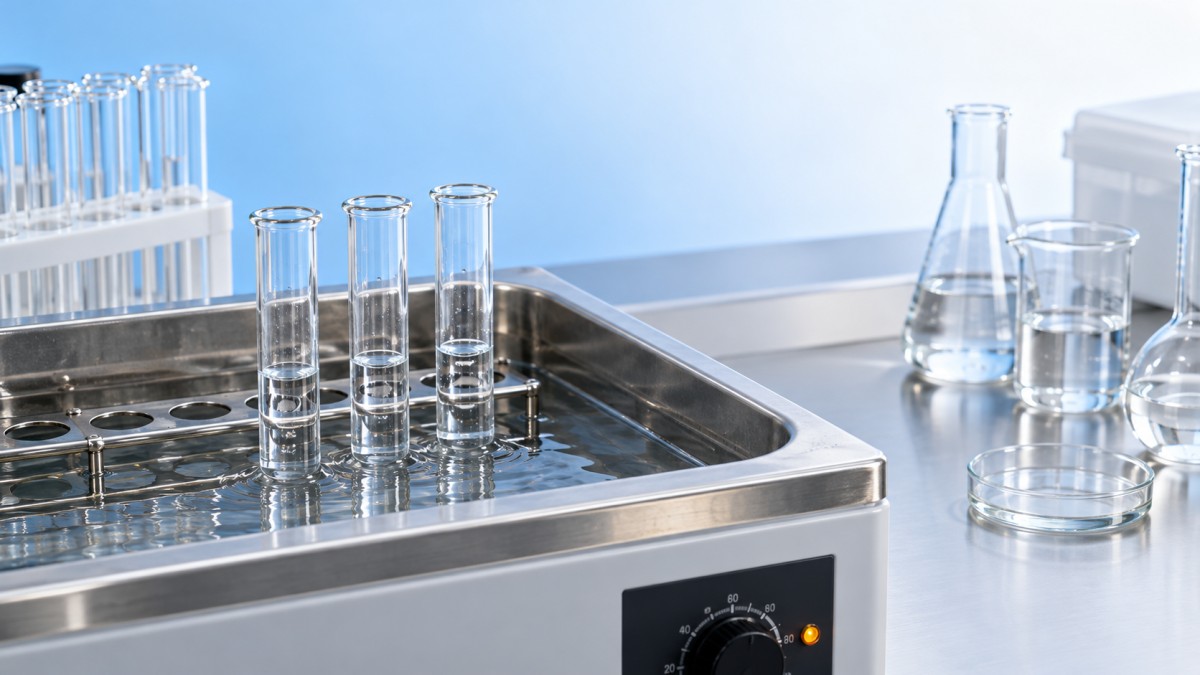
For controlled warming, a compatible bath or correctly sized heating block offers more distributed heat. Neither eliminates thermal shock: placing a cold tube directly into a hot bath still creates a rapid temperature change. A poorly fitting block can produce uneven contact, particularly if the tube touches only a few points or is forced into the well.
Cracks often start at damage that heating merely reveals
Small scratches, chips, and impact marks concentrate stress. A tube that survived previous heating cycles can fail after a minor knock during washing or storage. Repeated heating does not establish that its present condition is acceptable.
Inspect clean, dry tubes under good lighting before heating. Rotate each tube to examine the bottom, sidewall, and rim. Look for hairline cracks, chipped edges, deep scratches, star-shaped impact marks, or roughened patches. Residue can conceal damage, so inspect again after cleaning when the surface was initially obscured.
Remove visibly damaged tubes from heating service. A crack should not be tested by reheating, and a chipped rim should not be accepted simply because it lies above the liquid level. The rim experiences handling loads, and damage there can extend during temperature changes or gripping.
Cleaning tools deserve attention because they can create the flaws that later initiate a fracture. An exposed wire tip, forced brush, or abrasive cleaning method can damage the inner wall. Dried residue should be softened with a cleaning method compatible with both the glass and the substance before mechanical cleaning begins.
For narrow interiors, the Pipette Brush, model ML5500-4001, has white nylon bristles and an extra-long flexible galvanized-wire handle for removing residual liquids, reagents, or stains. Suitability requires enough clearance for the brush to move without force and compatibility with the cleaning solution. Keep exposed wire away from the glass, avoid pressing against the closed bottom, and replace a brush if worn bristles expose its core.
Surface damage can also develop chemically. Prolonged exposure to aggressive alkaline solutions, particularly at elevated temperature, can attack glass; hydrofluoric acid attacks it directly. A frosted or etched surface warrants investigation into chemical compatibility before further heating.
The transition out of heat can be the breaking point
Sudden cooling reverses the temperature gradient. The outer surface contracts while the hotter interior restrains it, generating stress near the surface. A tube can therefore survive heating and crack moments later when it touches a cold, wet bench or receives a splash.
Allow hot tubes to cool in a stable support suitable for the temperature and tube geometry. Keep them away from sink water, cold metal surfaces, and wet cloths. Do not rinse a hot tube or add cold liquid simply to speed cooling. If rapid cooling is part of a validated method, use the specified vessel and cooling sequence.
Liquid additions during heating create a similar problem from the inside. A cold reagent poured against a hot wall produces a local temperature change even when the bulk liquid remains warm. Where the method permits, bring additions to a compatible temperature and introduce them using the specified mixing procedure.
Wet exteriors complicate heating as well. Droplets create localized cooling as they evaporate, and moisture in a hot block can cause splashing or unstable contact. Dry the outside before placing a tube in equipment intended for dry heating. For a bath, follow the required immersion conditions and avoid abrupt temperature transitions.
Pressure and mechanical restraint can resemble thermal failure
A heated tube with a sealed opening is a pressure hazard. Expanding gas, vapor generation, or a chemical reaction can raise internal pressure until the glass fails. Ordinary test tubes are not pressure vessels. Loosening a cap slightly is not a reliable substitute for a defined venting arrangement, especially if condensate or residue obstructs the opening.
Use the closure and venting configuration specified by the procedure. Processes involving pressurized heating require vessels rated for the intended pressure and temperature. Sudden boiling can also eject liquid from an open tube, so an open mouth does not remove every heating hazard.
Mechanical restraint adds another source of stress. Tight clamps, rigid supports, or a tube wedged into a heating block restrict expansion and concentrate force at contact points. A clamp can also initiate a scratch before heating begins.
Support the tube securely without squeezing it or forcing it into a mismatched holder. Contact pads must suit the operating temperature, and the support should allow the movement required by the heating procedure. If failures repeatedly originate near a clamp jaw or block contact point, inspect that interface before attributing the problem to glass composition.
Use the failure pattern to narrow the investigation
Record when the crack appeared, where heating was applied, whether liquid was present, and what happened immediately beforehand. The following observations distinguish likely mechanisms without treating appearance as a definitive diagnosis.
Several mechanisms can operate together. A scratched tube may tolerate gentle warming but fail during rapid cooling. A tightly clamped tube may break at a lower thermal gradient than an undamaged, freely supported tube. Correcting only the most visible factor can leave the underlying vulnerability in place.
When repeated breakage warrants a closer look at the tubes
A single fracture does not establish a manufacturing defect. Repeated failures across several apparently undamaged tubes justify reviewing both the heating arrangement and the product specification. Confirm that the tubes are identified as borosilicate and approved for the intended heating method. Appearance alone does not establish composition, and a label such as “heat resistant” does not define acceptable direct flame use, thermal shock, or pressure exposure.
Relevant manufacturing variables include wall uniformity, the transition around the closed bottom, and residual stress from forming and annealing. An inclusion or local thickness change can affect where a fracture starts. Evaluating these features requires appropriate examination; casual inspection cannot confirm annealing quality.
For a useful investigation, retain the product identification and record the tube dimensions, heating method, liquid volume, temperature sequence, closure arrangement, cleaning history, and failure location. Photographs taken without handling sharp fragments can preserve evidence. Compare these records with earlier successful runs, looking for changed equipment, tighter holders, new cleaning chemistry, or a different tube specification.
After breakage, stop heating and manage hot liquid, broken glass, and sample hazards according to the laboratory procedure. Let equipment cool before inspection where appropriate, and use suitable tools for collecting fragments. Before restarting, identify a concrete correction to the suspected cause—such as a gradual temperature transition, a properly fitting support, or removal of damaged tubes—and verify it under the approved procedure.
Related Posts
Online Message
PROFESSIONAL CONSULTATION
If you are interested in our products and want to know more details, please leave a message here, we will reply you as soon as we can.