


Choose lab tubes whose documented maximum relative centrifugal force (RCF) covers your protocol under the conditions you will actually use. Those conditions include the rotor and adapter, sample volume and density, temperature, spin duration, and closure. A tube that fits the rotor can still be unsuitable for the run, and a high force rating is useful only when its operating limits match your application.
The practical starting point is to define the centrifugation step, then compare complete tube configurations against it. Comparing products by capacity, material, or a headline “maximum speed” alone leaves too much unanswered.
Start with the force required by the protocol
RCF describes centrifugal acceleration relative to gravity and is commonly written as × g. RPM describes how fast the rotor turns. These values are related, but they are not interchangeable: at the same RPM, a larger rotational radius produces greater RCF.
This distinction matters when moving a method between centrifuges. Copying an RPM setting from another instrument may change the force applied to the sample, even if the tube size remains identical. That can affect pellet formation, separation quality, and the mechanical load on the tube.
The standard relationship is:
RCF = 1.118 × 10⁻⁵ × r × RPM2, where r is the rotational radius in centimeters.
Use the radius specified for the relevant rotor and tube configuration. A protocol may refer to maximum RCF at the tube bottom or average RCF across the sample. These are different reference points. An adapter or a change in tube geometry can alter the sample’s position, so a conversion based on an unrelated rotor radius can produce the wrong setting.
If the protocol provides only RPM, establish the original rotor geometry before transferring the method. If it specifies RCF, check which radius convention the centrifuge uses when displaying force. Matching the displayed number is meaningful only when the reference points agree.
Before reviewing tube options, capture the following requirements in one working specification:
- Required RCF and its reference point.
- Duration, number of spins, and acceleration or braking settings where the method specifies them.
- Operating temperature and any preceding freezing, heating, or sterilization.
- Sample volume, composition, and expected density.
- Rotor model, rotor type, adapter, and closure requirements.
This gives purchasing and laboratory staff a common basis for comparison. It also prevents a tube approved for one centrifugation step from being used automatically for every step in the workflow.
Read the force rating as a conditional limit
A maximum RCF rating applies to a defined product under specified conditions. It is not a universal property of every tube made from the same plastic. Wall thickness, base shape, manufacturing design, closure, and support within the rotor all affect performance.
Look for documentation tied to the exact catalog number. A general statement about a product family may not distinguish between capacities, cap styles, sterile versions, or other variants. Similarly, “centrifuge compatible” does not establish a usable maximum force.
When a required condition is absent, request a written specification addressing that condition before accepting the product. A rating measured with an aqueous sample does not automatically establish suitability for a denser gradient medium or concentrated suspension. Greater sample density increases the load at the same RCF.
A rating above the required force can provide useful operating headroom, but there is no universal percentage that makes a tube suitable. Extra rated capacity cannot compensate for an unsupported tube base, an incompatible solvent, or an unapproved cap. Avoid operating beyond a documented limit on the assumption that a short spin will be harmless.
Check how the rotor supports the tube
Nominal capacity is a poor substitute for dimensional compatibility. Two tubes holding the same volume can differ in overall length, outside diameter, taper, base profile, and cap clearance. These differences affect whether the tube seats correctly and receives the support its design requires.
In a fixed-angle rotor, the tube sits at an angle and the sample loads the outer wall during centrifugation. In a swinging-bucket rotor, the bucket changes orientation during the run. A tube rating established for one arrangement should not be carried over to another unless the documentation covers that use.
Inspect the complete assembly: rotor cavity or bucket, adapter, tube body, and closure. The tube should seat as intended without being forced into place. A mismatched adapter may leave part of the wall or base unsupported, while an oversized cap may interfere with the rotor lid or bucket movement.
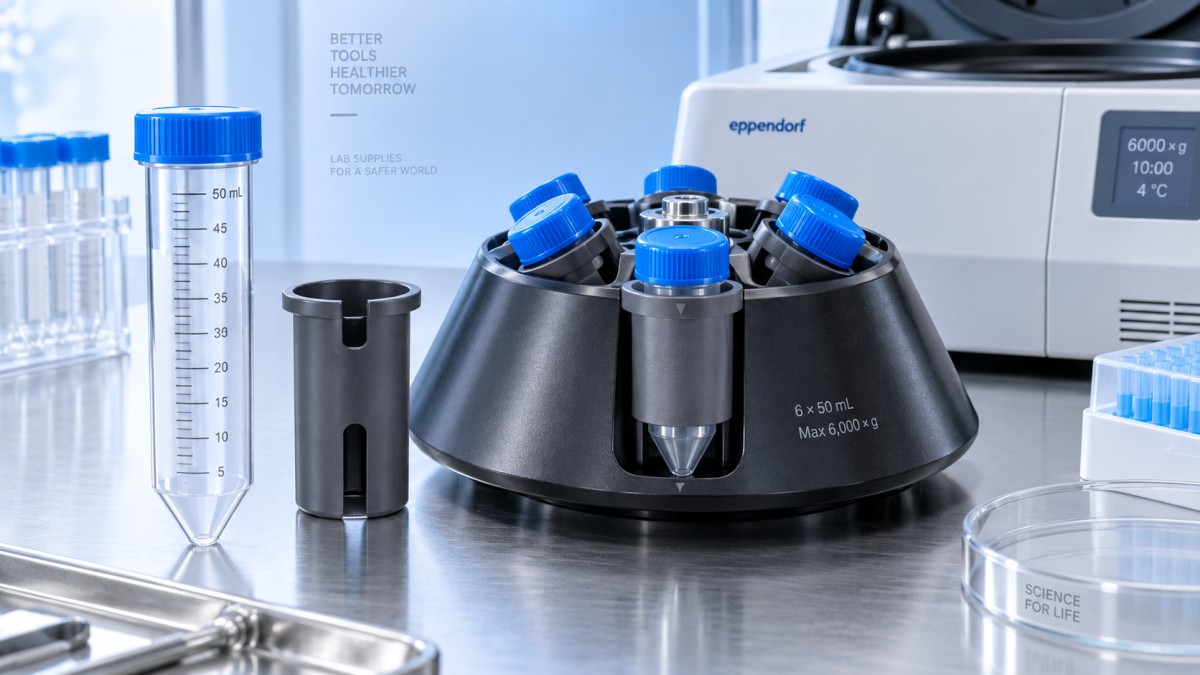
For conical tubes, confirm that the adapter supports the intended profile. For round-bottom tubes, confirm that the base sits properly in the holder. Where sleeves, cushions, or dedicated adapters are specified, include them in the approved configuration and purchasing list.
The allowable operating setting is constrained by the lowest applicable limit in the assembly. The centrifuge, rotor, bucket, adapter, tube, and closure may each impose restrictions. A stronger tube does not increase the rotor’s permitted speed.
After establishing compatibility, balance loaded assemblies according to the centrifuge instructions. Matching liquid volumes alone may not balance tubes with different masses, caps, adapters, or sample densities.
Material and sample compatibility can outweigh the headline RCF
Polypropylene is commonly used for centrifuge tubes, but the material name alone does not establish strength, chemical resistance, or temperature suitability. Those properties must be assessed for the finished product and the intended exposure.
Polystyrene is used for various laboratory containers where clarity is useful. That does not make a polystyrene container suitable for demanding centrifugation. Glass tubes also require explicit centrifugation suitability and compatible support; ordinary laboratory glassware should not be selected simply because it fits.
Review the complete sample composition, including solvents, extraction reagents, acids, bases, and cleaning residues. Chemical exposure may weaken a tube or closure before obvious damage appears. Exposure time and temperature matter alongside chemical identity.
The sample’s analytical requirements also affect selection. Protein adsorption, nucleic acid recovery, extractables, and contamination can matter even when the tube performs mechanically. Sterility, low-binding treatment, and nuclease-related specifications address separate needs. None replaces an adequate RCF rating.
For blood collection tubes, evaluate the intended collection and separation system, including additives or separator gel. Their centrifugation conditions belong to that specific application. A collection tube and a general-purpose centrifuge tube should not be treated as interchangeable because their dimensions are similar.
Choose the material and surface properties that support the method, then verify the force rating of that exact product. Choosing the highest-rated tube first can still leave you with a container that compromises sample recovery or preparation.
Volume, temperature, and closures need their own checks
Printed capacity describes how much a tube can hold; it does not necessarily describe its permitted centrifugation fill range. Some designs need a specified filling level for support, while others require headspace. Thin-walled tubes used in demanding applications may have particularly specific filling and closure instructions.
Evaluate the smallest and largest volumes used in the method. A configuration acceptable at the routine volume may not cover a low-volume preparation or a near-capacity batch. Do not assume that a less-filled tube is always under less problematic stress: support and deformation behavior also depend on design.
Temperature requires the same attention. Plastic stiffness, toughness, and dimensional stability can change with temperature. A rating established at room temperature should not be extended automatically to refrigerated or warmer operation.
Previous handling matters too. Freezing, thawing, autoclaving, chemical exposure, or repeated use can affect a tube’s condition. Select a product documented for the complete handling sequence. Single-use tubes should not be treated as reusable centrifuge vessels because they survived the first run.
The closure is part of the selection. Screw caps and snap caps have different handling characteristics, but neither type establishes containment by itself. Check the specified cap, seal or gasket where present, thread engagement, and closing instructions. Excessive tightening can damage a closure just as inadequate tightening can leave it insecure.
A cap advertised as leak-resistant during storage does not, by that description alone, establish aerosol containment during centrifugation. Where the workflow requires containment, assess the relevant sealed rotor or safety-bucket system as well as the tube. Exterior contamination during loading and opening remains a separate handling concern.
Separate mechanical suitability from separation performance
A tube can tolerate the run and still produce an unsuitable result. Changing tube geometry changes the sample depth, sedimentation path, pellet location, and access for removing the supernatant. Rotor geometry and braking behavior can also affect separation and pellet disturbance.
This is particularly relevant when replacing one tube format with another. Matching RCF and sample volume does not guarantee equivalent pelleting time or recovery. A wider tube, a different taper, or a change between fixed-angle and swinging-bucket operation may require method evaluation.
Start with candidates that meet the documented mechanical requirements. Then assess the outcomes that matter to the protocol: pellet integrity, supernatant clarity, recovery, ease of aspiration, and downstream assay performance. For cell-containing samples, include the cell quality or viability measures relevant to the application.
Do not reduce force merely to accommodate a weaker tube unless the revised separation conditions have been established for the method. Increasing spin time may change sedimentation, but it does not automatically reproduce the original result. Conversely, purchasing a tube with a higher rating is not a reason to increase protocol force.
Turn the selection into an approval that can be reused
A defensible purchasing decision identifies the exact tube and its approved conditions. Record the catalog number, capacity, material, closure, maximum permitted RCF, temperature and filling limits, and compatible rotor and adapter. Keep the supporting specifications with the method record.
For products sourced through distributors or export suppliers, product identity deserves particular attention. Similar photographs, packaging descriptions, or capacity labels do not establish technical equivalence. Ask suppliers to identify the manufacturer and exact configuration covered by their documentation, and establish how substitutions or specification changes will be communicated.
Before routine adoption, run a controlled evaluation within the documented limits using representative operating conditions. Check seating, closure handling, leakage, deformation, and the relevant separation results. A successful trial supports workflow suitability; it does not establish a new maximum RCF or authorize use outside the stated limits.
Approve the tube together with its rotor, adapter, filling range, temperature, and protocol settings. That makes future reordering straightforward and gives staff a clear trigger for review when any part of the configuration changes. The immediate next step is to compare your protocol requirements with the exact candidate’s operating limits, resolving missing conditions before placing a routine order.
Related Posts
Online Message
PROFESSIONAL CONSULTATION
If you are interested in our products and want to know more details, please leave a message here, we will reply you as soon as we can.