


How to choose a urine container for a 24-hour collection
Choosing the right urine container for a 24-hour collection is more than a routine purchasing decision. It affects specimen integrity, patient usability, and the work required when the sample reaches the laboratory. A bottle may look suitable in a catalog yet become awkward when filled, leak after repeated opening, or lack space for the collection details the laboratory needs.
The sensible starting point is the receiving laboratory’s protocol—not the lowest unit price or the largest available container. Capacity, closure design, material compatibility, storage conditions, and preservative requirements must work together. For institutions and distributors, reliable supply also means knowing that the product approved during evaluation will be the product delivered on repeat orders.
Define the collection protocol before comparing bottles
A 24-hour collection is not simply a larger version of a spot urine sample. It involves collecting urine over a defined period, often at home, with repeated transfers into the same vessel. Missing a void, spilling part of the collection, or recording the timing incorrectly may compromise the result even when the container itself performs perfectly.
Before requesting quotations, obtain the laboratory’s written requirements for the intended tests. Confirm whether the specimen needs a preservative, protection from light, refrigeration, or another specified storage condition. Also establish whether the laboratory receives the entire collection or accepts an aliquot prepared under its own procedure. These details change the purchasing specification.
Do not assume one bottle can serve every test. Some assays require different collection conditions, and incompatible requirements may mean separate collections rather than a universal container. That decision belongs to the laboratory. Procurement should translate it into clearly differentiated stock items, with labeling that makes substitution difficult.
Choose usable capacity, not just a catalog volume
Containers around 2–3 liters are common options, but neither size is automatically sufficient for every patient. Higher urine output can require additional capacity. Ask the supplier whether the stated volume represents recommended working capacity, the highest graduation, or brimful capacity. These are not interchangeable, particularly when the container must be carried without spilling.
A larger vessel reduces the chance of running out of space, but brings trade-offs. It may be harder to grip, occupy more refrigerated storage, and cost more to ship. A smaller vessel is easier to handle until a patient needs a second one. The collection service therefore needs a laboratory-approved overflow procedure, including how additional containers are issued, identified, and processed together.
Graduations are useful for orientation, but do not automatically make a collection bottle a calibrated measuring device. If total urine volume is used in calculating the reported result, the laboratory should define how that volume is measured. Ask for graduation tolerances if accuracy is claimed; otherwise, treat the molded scale as approximate.
Inspect the closure as part of the whole container
Leak resistance depends on the bottle neck, threads, cap, and any liner or seal working together. A tight-feeling cap is not proof of a reliable seal. Cross-threading, an uneven neck finish, or a liner that moves during repeated opening can turn a seemingly acceptable sample into a problem during transport.
Evaluate samples under realistic handling conditions. Using a safe test liquid and a documented procedure, check the closure after repeated opening and closing, side positioning, and simulated transport. Include the intended storage conditions where relevant. For preservative-containing products, any chemical compatibility assessment should be controlled by appropriately trained personnel—not improvised during a purchasing review.
Ask users to open and close the cap with wet hands or gloves. A deeply ribbed cap may provide better grip, but sharp edges and excessive tightening force create other difficulties. Check the handle with the bottle filled to its intended working volume. An empty container tells you little about balance, handle comfort, or how easily the cap can be secured while the bottle is supported.
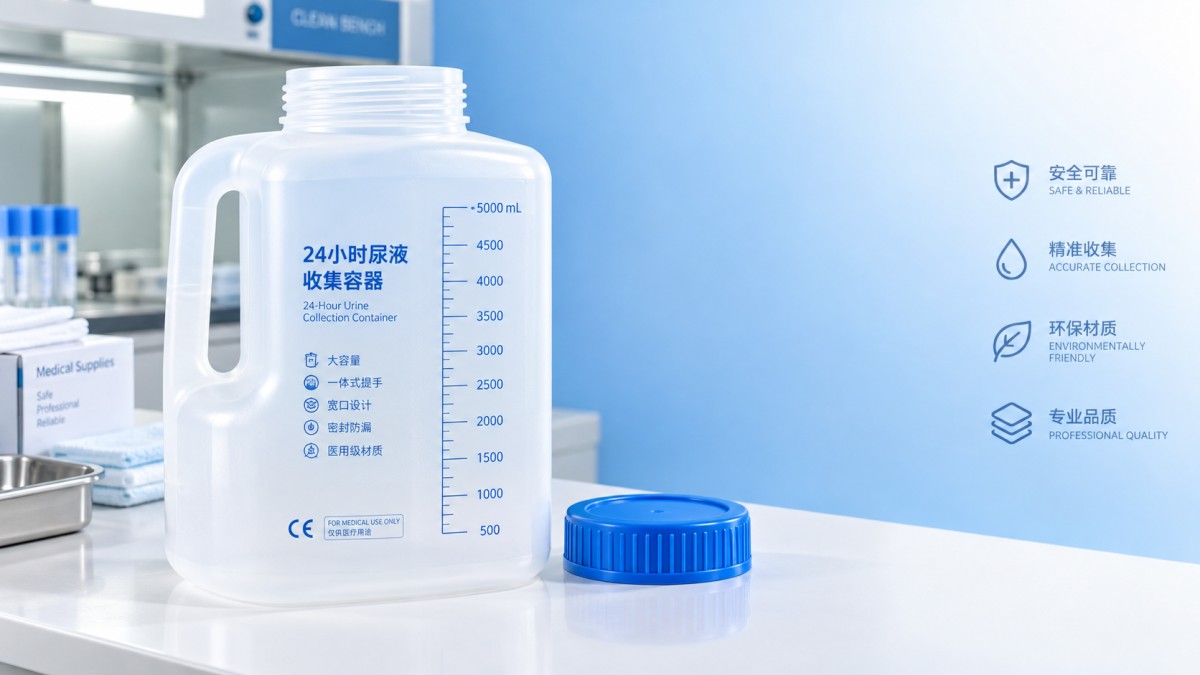
The opening deserves equal attention. A wide neck can make transfer easier, while a narrower opening may offer more controlled pouring at receipt. Neither is universally better. Consider whether patients will use a separate collection aid, how staff will transfer the specimen, and whether the supplied instructions explain that process clearly.
Match material and preservation to the actual test
Polyethylene and polypropylene are commonly used for specimen containers, but the polymer name alone is not enough to approve a product. The complete assembly matters, including colorants, cap materials, liners, and any additives. Request compatibility information relevant to the specified preservative, storage temperature, and collection duration.
For tests requiring light protection, confirm what the laboratory accepts. An amber or opaque appearance does not, by itself, establish suitable light protection. Similarly, “medical grade” is too broad to replace product-specific evidence. The useful question is whether this exact container is suitable for the laboratory’s intended collection and analytical method.
Preservatives require particular care. If supplied preloaded, confirm the substance, quantity, shelf life, labeling, and applicable handling documentation. Some preservatives are hazardous. Patients should not be expected to choose or add chemicals themselves, and direct urination into a container holding a hazardous preservative should be avoided. The laboratory’s instructions should specify safe collection and transfer.
Sterility is another specification that should be justified rather than added automatically. A routine timed chemistry collection and a microbiological investigation have different needs. Paying for a sterile bottle does not correct an incomplete collection or unsuitable preservation. Let the receiving laboratory determine the required cleanliness or sterility level for the intended use.
Make the label and instructions survive home use
Labels need to remain readable after handling and the specified storage conditions. Check adhesion on the actual bottle surface, including exposure to condensation where refrigeration is required. A generous labeling panel is useful only if it remains visible when the bottle is carried and does not interfere with the handle or closure.
At minimum, the collection service should define space for patient identification, collection start and finish times, and any required preservative or hazard information. Where multiple containers may be issued, there should be a clear way to link them to the same collection. Barcode placement should be checked against the laboratory’s receiving workflow rather than decided solely for packaging convenience.
Instructions should explain the timing in plain language. Typically, the initial void is discarded and its time recorded; subsequent urine is collected, including the final void at the prescribed end time. The exact procedure, storage requirements, and response to a missed or spilled sample must follow the laboratory’s protocol. Include a contact route so patients do not have to guess whether to continue or restart.
Use supplier documentation to prevent silent substitutions
A useful supplier file connects the quotation, specification, sample, and delivered product through a consistent product code. It should identify materials, dimensions, capacity definitions, packaging configuration, and lot traceability. Where sterility or preservative content is claimed, request the relevant supporting documentation. Confirm applicable destination-market requirements separately; a generic certificate does not establish compliance for every jurisdiction.
This product-specific discipline matters when buying across a broad laboratory catalog. For example, a PS Petri Dish may be selected for optical clarity, a flat base that supports uniform agar thickness, and vent configurations suited to gas exchange. Those characteristics address culture work, not timed urine collection. Its polystyrene material and stated E.O. sterile status should not be treated as evidence that a separate collection bottle has suitable chemical compatibility or sterility.
In medical-device export, experience is most useful when it translates into dependable documentation, honest specifications, and responsive service. An established exporter serving institutions, laboratories, and distributors across multiple markets should be able to coordinate those details, not merely send a catalog. Ask who handles complaints, how replacement batches are traced, and whether changes to the cap, resin, liner, or manufacturing site require advance notification.
Approve the working system, then compare its cost
Before placing a volume order, run a small evaluation involving laboratory receiving staff and the team issuing collection kits. Check filled-container handling, label readability, storage fit, transfer control, and packaging condition. Record the acceptance criteria in advance so approval does not depend on one person’s impression of a sample.
- Confirm that the exact bottle and closure match the approved laboratory protocol.
- Agree on capacity limits and the procedure when an additional container is needed.
- Check that instructions and hazard information match the supplied configuration.
- Document incoming inspection points and supplier change-notification expectations.
Then compare landed cost, not bottle price alone. Freight volume, secondary packaging, labels, collection aids, storage space, and replacement handling can change the economics. A cheaper urine container is not a saving if its closure creates avoidable rework. Equally, paying more for features the laboratory does not need is difficult to justify.
Choose the simplest configuration that meets the test requirements and remains manageable throughout collection, storage, and transport. Keep the approved specification and reference sample available for future orders. The practical purchasing question is not whether the bottle looks suitable—it is whether the next delivered batch will support the same collection process without introducing a new risk.
Related Posts
Online Message
PROFESSIONAL CONSULTATION
If you are interested in our products and want to know more details, please leave a message here, we will reply you as soon as we can.