


How to tell whether measuring pipettes require blow-out dispensing
Should you expel the last drop from your Measuring Pipettes or leave it in the tip? The wrong choice can affect delivered volume and compromise laboratory results. Blow-out dispensing depends on the pipette’s design and calibration—not simply whether liquid remains after draining. The most reliable answer comes from the manufacturer’s instructions for the exact product, supported by its markings and graduation pattern.
For routine sample preparation and clinical laboratory workflows, the practical rule is straightforward: blow out the residual liquid only when the pipette’s specified delivery procedure requires it. If the instrument is calibrated to deliver by gravity while retaining liquid in the tip, forcing that liquid out changes the delivered volume. A visible drop is therefore a reason to check the dispensing method, not automatically a reason to press the controller’s blow-out button.
Start with the delivery instructions, not the remaining drop
Blow-out dispensing means using air pressure to expel the residual liquid after the main delivery. It is different from allowing a pipette to drain freely, and different from touching the tip against the receiving vessel to remove an external hanging drop.
The distinction matters because calibration accounts for a particular handling procedure. Some pipettes deliver their stated volume after gravity drainage, with a small amount deliberately left inside. Others require the final residual liquid to be expelled to complete the intended delivery. Neither design is inherently better; problems begin when an operator applies one procedure to the other.
Before using an unfamiliar pipette, look for an instruction such as “blow out,” “do not blow out,” “free discharge,” or a defined drainage and waiting procedure. Check the individual wrapper, carton label, technical sheet, or instructions for use. Match the information to the catalogue number and capacity, rather than relying on a document for a similar-looking product.
If the documentation is silent, do not settle the question by observing which technique seems to empty the pipette more neatly. For quantitative work, an unidentified delivery method is a reason to pause and obtain clarification.
What the markings can—and cannot—tell you
Many measuring pipettes carry several kinds of markings close together: volume, graduation intervals, calibration temperature, delivery designation, and sometimes a blow-out symbol. Read them as separate pieces of information.
“TD” or “Ex” does not automatically mean blow out
“TD” means “to deliver,” while “Ex” is another designation for delivery calibration. These markings indicate that the pipette is intended to deliver a stated volume using its prescribed procedure. They do not, by themselves, tell you whether that procedure includes blowing out residual liquid.
“TC” or “In” indicates calibration to contain. Do not treat such a pipette as interchangeable with a delivery-calibrated instrument. Its transfer procedure may require additional steps defined by the manufacturer or laboratory method.
Rings are useful clues, but identification conventions vary
On many traditional laboratory pipettes, two rings near the upper end identify a blow-out design. However, ring styles and marking conventions are not universal across manufacturers and product families. A coloured band may identify capacity rather than dispensing technique, and the absence of familiar rings does not prove that a disposable plastic pipette is non-blow-out.
Use rings as supporting evidence. If their meaning is unclear, compare them with the manufacturer’s marking guide rather than borrowing the interpretation from another brand.
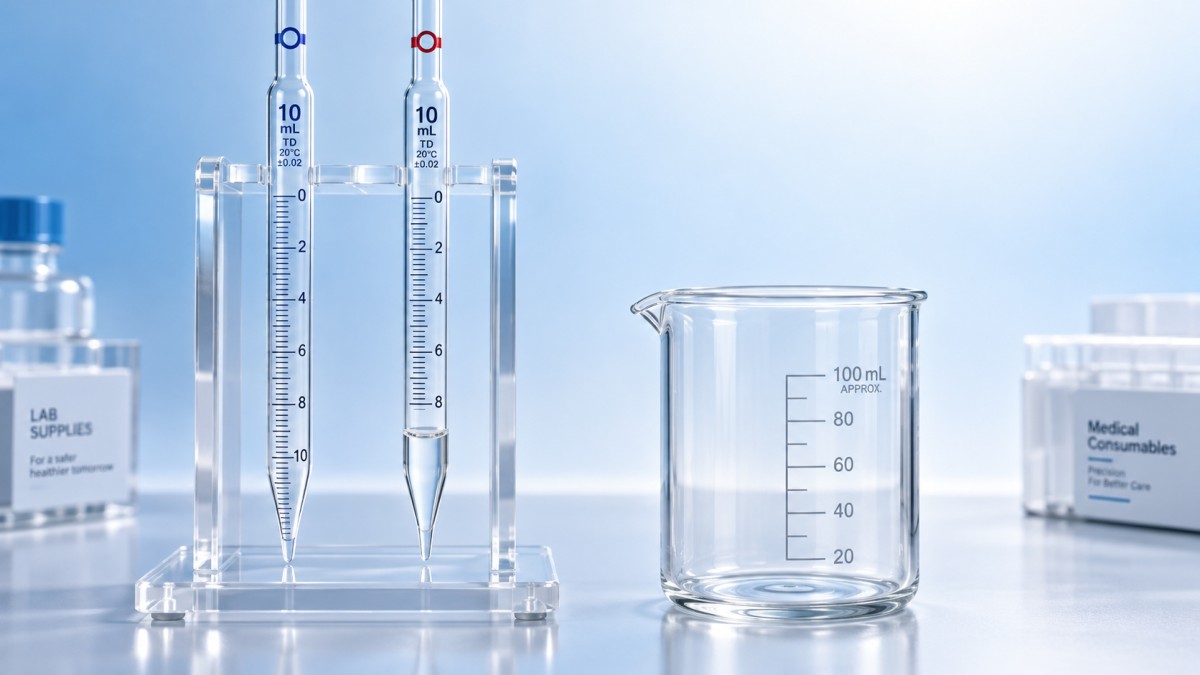
For a bench reference image, the useful comparison is between the upper identification markings and the lower graduation endpoint. Both areas matter; a photograph showing only the tip cannot reliably establish the required dispensing method.
Use the pipette type to narrow the question
The graduation layout helps explain how a pipette is intended to work, although it should not override explicit product instructions.
The most consequential distinction is often not glass versus plastic. It is whether the measured delivery ends at another graduation line or at the pipette’s empty endpoint.
Suppose a method requires transferring liquid between two marked positions on a graduated pipette. Stop the meniscus at the specified finishing mark. Blowing out everything remaining would deliver liquid beyond the measured interval—even if that pipette requires blow-out for a full delivery to empty.
This is an easy mistake when operators hear “serological pipettes are blow-out pipettes” and apply that statement to every transfer. The product’s delivery designation and the method’s volume endpoint must be considered together.
A practical check before dispensing
When opening a new box or changing suppliers, a short identification check is more useful than troubleshooting inconsistent volumes later:
- Confirm the capacity and catalogue number against the laboratory procedure.
- Locate the delivery designation and any blow-out instruction or symbol.
- Determine whether the transfer ends at a graduation mark or requires emptying the pipette.
- Check the prescribed drainage, waiting, and tip-contact steps.
- Confirm which controller control provides drainage and which provides blow-out.
Do not assume that a controller’s strongest setting is the correct one. Depending on the device, liquid may be released by gravity or driven out by the motor. The controller manual explains its controls; the pipette instructions determine the appropriate delivery technique. Both need to agree with the laboratory’s validated procedure.
Once the method is established, keep the pipette upright when reading the meniscus and avoid parallax. For clear aqueous liquids, the bottom of the meniscus is generally the reading point, unless the method specifies otherwise. Check for bubbles before starting: a correct blow-out technique cannot repair an incorrectly measured starting volume.
Where disposable plastic pipettes fit into the decision
In clinical and research laboratories, disposable plastic serological pipettes are convenient for transferring millilitre-scale volumes without cleaning reusable glassware. However, sterility, capacity, graduation spacing, and blow-out requirements are separate specifications.
For example, Serological Pipettes, Plastic are listed in transparent polystyrene, with capacities of 1, 2, 5, 10, 25, and 50 mL. Their listed subdivisions are 0.01, 0.02, 0.1, 0.1, 0.2, and 0.5 mL respectively, with ascending/descending graduation options and sterile or non-sterile availability. Those details help match a pipette to a transfer task, but they do not establish its blow-out procedure.
Negative graduations also need care. They provide additional scale markings above the nominal zero position; they are not blow-out indicators. Likewise, a fine subdivision is a reading interval, not a guarantee of equivalent measurement accuracy.
In our medical-device export work with laboratories, medical institutions, and distributors across multiple markets, clear product identification belongs alongside quality and supply support. For this question, the useful service is obtaining the delivery instruction for the exact model—not making a general assurance that all pipettes in a category behave alike.
When correct identification still does not give consistent delivery
A pipette may be correctly identified and still produce variable results if handling changes between operators. Rushing the drainage step, touching the vessel differently, or using inconsistent pressure can affect repeatability. Where instructions specify a waiting time, follow that time rather than substituting a familiar routine from another pipette.
Viscous, foaming, or strongly wetting liquids deserve particular attention. A slow-moving film on the wall is not necessarily the same as the normal residual liquid covered by the delivery procedure. Do not compensate by adding extra air pulses, rinsing the pipette into the sample, or extending drainage arbitrarily. Use a method demonstrated to work for that liquid and required volume.
In biological workflows, forceful blow-out can also cause splashing or bubbles. If blow-out is required, apply it in a controlled manner with the receiving vessel positioned appropriately under the laboratory’s biosafety procedure. Never mouth-pipette, and avoid aspirating liquid into the controller.
If a laboratory needs to investigate a delivery discrepancy, a controlled gravimetric check can help assess performance under a defined procedure. Such a check requires suitable equipment and attention to temperature, evaporation, and liquid density. It should not be used to guess an undocumented delivery method or replace manufacturer clarification.
Make the endpoint explicit in the bench procedure
An instruction that says only “pipette 5 mL” leaves too much room for interpretation. A clearer procedure identifies the pipette, the starting and finishing positions, and whether the delivery includes gravity drainage, a waiting period, tip contact, or blow-out.
Before expelling the last drop, answer two questions: does this exact pipette require blow-out, and does this transfer end at empty? If either answer is uncertain, check the product documentation before proceeding. The correct endpoint is the one defined by calibration and the method—not the one that leaves the tip looking driest.
Related Posts
Online Message
PROFESSIONAL CONSULTATION
If you are interested in our products and want to know more details, please leave a message here, we will reply you as soon as we can.