


A 1.5ml micro-centrifuge tube has a nominal capacity of 1.5 mL, or 1,500 µL. Its appropriate working volume is the amount supported by the tube specifications and the intended procedure. A full 1.5 mL load is suitable only when the manufacturer permits that volume under the planned conditions. Mixing, heating, freezing, or adding reagents can require a smaller starting volume.
There is no universal working-volume limit for every tube labeled “1.5 mL.” The useful question is how much liquid the tube will contain at the most demanding stage of the procedure, and whether sufficient space remains for movement, expansion, additions, and secure closure.
Nominal capacity, physical capacity, and working volume
Nominal capacity identifies the tube’s stated size. Physical capacity describes how much its internal cavity can contain, potentially including space above the highest graduation. Working volume describes the liquid volume appropriate for a particular operation. These values serve different purposes and should not be treated as interchangeable.
A tube might physically accept liquid above its 1.5 mL mark, but that extra space does not establish an approved operating volume. Liquid near the opening can wet the sealing surfaces, interfere with closure, or escape when the cap is opened. Filling to the brim is therefore a poor way to determine usable capacity.
The manufacturer’s terminology also matters. A specification that states “maximum volume” should be read together with its test conditions. A centrifugation limit does not automatically establish suitability for heating or vigorous mixing. Likewise, a stated maximum centrifugal force does not prove that every fill level is acceptable at that force.
Headspace is the space between the liquid and the closed cap. Its usefulness depends on tube geometry and the procedure. A visible gap above the liquid does not reveal an exact spare volume, especially where the tube’s shoulder narrows toward the opening.
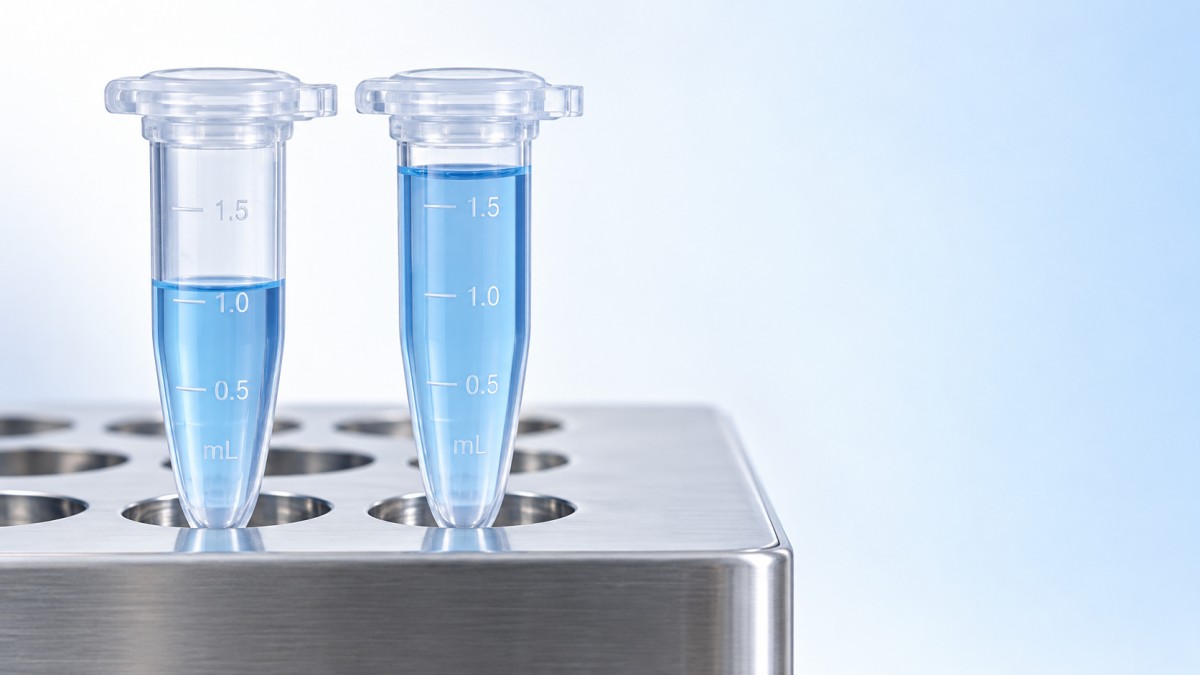
A cross-sectional comparison of a moderate fill and a near-cap fill helps explain this distinction: both fit inside the tube, but they leave different amounts of space for liquid movement and different distances between the sample and the closure.
Calculate the final volume before choosing the starting fill
The starting sample volume often understates the largest volume reached during a procedure. Buffers, wash solutions, enzymes, solvents, and other additions all count toward the liquid load. A tube that comfortably holds the initial sample can become unsuitable after the next addition.
For example, 900 µL of sample plus 400 µL of buffer gives a total liquid volume of 1,300 µL. That arithmetic establishes the expected load; it does not establish that 1,300 µL is an approved working volume. The resulting fill still needs to suit the mixing, temperature, centrifugation, and closure conditions.
Plan around the largest simultaneous volume, rather than adding every volume used throughout the protocol. If a supernatant is removed before a wash solution is introduced, those volumes are not present together. Conversely, residual liquid left above a pellet contributes to the next step’s total and should not disappear from the calculation.
Solid material requires additional consideration. Tissue fragments, beads, precipitates, or an inserted sampling component occupy space. Their presence also changes liquid movement and access for a pipette tip. A stated liquid volume alone does not describe how crowded the tube will become.
When the expected total approaches the supported limit, a larger compatible tube or a protocol-approved division into aliquots provides more room. Splitting a sample can change recovery, concentration, or handling losses, so it should fit the method rather than be improvised during processing.
The same fill behaves differently during mixing and centrifugation
For gentle handling, the main concerns are secure closure and clean access to the sample. Vigorous vortexing places different demands on the available space. Liquid moves along the walls, reaches the cap, and can form foam. A volume that sits comfortably below the opening while stationary can wet the closure during agitation.
Mixing quality also changes with fill level. A nearly full tube limits the space available for circulation, while a smaller fill allows more movement. The exact result depends on the liquid’s viscosity, mixing speed, tube geometry, and any solids present. Reducing volume is useful only if the resulting conditions still meet the method’s mixing requirements.
Foam deserves separate attention because it occupies space without representing additional liquid. Protein-containing solutions, detergents, and other foam-forming mixtures can spread toward the closure during mixing. Increasing agitation to compensate for poor mixing can make this worse. The relevant working volume must accommodate the sample’s behavior, not just its measured amount.
During centrifugation, volume must be considered alongside relative centrifugal force, usually expressed as × g. Revolutions per minute alone do not describe the force applied because rotor radius also matters. The tube’s force rating should therefore be compared with the actual run conditions, including temperature and duration where specified.
Rotor fit matters too. A poorly supported tube can deform even when its liquid volume seems reasonable. The correct rotor cavity or adapter supports the tube as designed. Matching opposing loads remains necessary; equal liquid volumes do not guarantee equal masses when sample compositions differ.
Heating and freezing need their own filling limits
Heating changes both the liquid and the sealed environment above it. Liquid expansion reduces available headspace, while vapor pressure can increase pressure inside the tube. Closure design, chemical composition, temperature, and exposure time determine whether the assembly is suitable.
Additional headspace alone does not make an unsuitable tube safe for heating. A cap lock cannot establish temperature or pressure compatibility, and opening the cap to relieve pressure changes evaporation and contamination conditions. The selected fill should follow the method and the tube’s stated limits, including any required closure accessories.
Evaporation can also change the analytical result without producing an obvious spill. Loss of solvent increases sample concentration. Condensation beneath the cap redistributes liquid and can complicate recovery. After cooling, a brief centrifugation step can return droplets to the bottom when the method permits it.
Freezing introduces a different issue. Water-rich liquids expand as they freeze, making a near-full load unsuitable where the specified storage procedure requires expansion space. Tube material and cap performance at the intended temperature must also be appropriate. Suitability for routine centrifugation does not establish suitability for frozen storage.
For repeated freeze–thaw handling, aliquot size should reflect the amount needed for each use. A tube selected solely to minimize empty space can leave insufficient room for expansion or later additions. Documenting both the stored volume and the storage conditions makes the fill decision reproducible.
Graduations help estimate volume; they do not verify it
Molded graduations are useful for orientation and rough volume assessment. They should not replace a suitable calibrated pipette when accurate liquid measurement matters. Mark visibility, meniscus shape, tube angle, and the conical bottom affect how the level appears.
A visual estimate of “about 1.5 mL” can become especially unreliable with foam, suspended solids, or droplets coating the walls. Measure additions with equipment appropriate to the liquid. Viscous or volatile samples require a suitable pipetting technique because an incorrect delivered volume affects both the assay and the remaining space.
Underfilling presents a separate set of concerns. A small sample in a 1.5 mL tube has ample headspace, but recovery can be difficult if droplets remain on the wall or cap. For very small quantities, evaporation and adsorption to the surface can represent a larger fraction of the sample.
A smaller vessel or a low-binding tube is worth considering when recovery drives the choice, provided it meets the method’s requirements. The nominal size of a tube therefore sets only part of the decision: the useful range also depends on how reliably the sample can be handled and recovered.
Sampling workflows add more than just liquid
In workflows involving a Collection Swab, distinguish between transferring an eluate and placing the sampling device inside the tube. The supplied product information describes sampling swabs with wooden or plastic shafts and viscose tips, with sterile and non-sterile options. It does not establish compatibility with a particular microcentrifuge tube or extraction method.
If only the recovered eluate enters the tube, its measured volume becomes part of the normal fill calculation. If a swab tip or shaft segment remains inside, it displaces space, retains some liquid, and can obstruct closure or pipette access. A nominal 1.5 mL liquid capacity cannot be used as the combined allowance for liquid and an inserted device.
The stated swab length of 150 mm also means that an intact device should not be assumed to fit a small tube. Cutting or breaking a shaft requires a method designed for that action; otherwise, fragments, contamination, or closure interference can result. Use the specified extraction vessel and transfer arrangement for the sampling procedure.
Interpret leakage before changing the fill
Liquid beneath the cap after vortexing does not necessarily mean the tube leaked. Droplets can remain inside the closed tube and fall back after a brief spin. Liquid on the outside, however, indicates a containment problem that needs investigation before further handling.
Excessive filling is one possible cause, but so are incomplete cap engagement, damaged sealing surfaces, incompatible chemicals, and operation outside the tube’s temperature or force limits. Lowering the volume will not correct a cracked tube or an unsuitable material. Many microcentrifuge tubes are polypropylene, yet that material description alone does not establish compatibility with every solvent or treatment.
Where several tube designs share the same nominal capacity, record the specific tube reference and the approved working volume in the procedure. Include the largest liquid load and the conditions that justify it. This avoids treating a replacement 1.5 mL tube as automatically equivalent merely because its label shows the same size.
Use 1,500 µL as the nominal capacity reference. Set the actual working volume from the supported conditions of the exact tube and the complete procedure, leaving the space required by what happens after filling.
Related Posts
Online Message
PROFESSIONAL CONSULTATION
If you are interested in our products and want to know more details, please leave a message here, we will reply you as soon as we can.