


A compatible collection swab for COVID testing must match the assay’s accepted specimen type, swab specifications, and sample handling procedure. A swab labeled “for COVID testing” does not establish compatibility with a particular test. The strongest starting point is the assay’s instructions for use, including any collection accessories or alternatives identified by the manufacturer.
Compatibility belongs to the complete collection pathway: sampling site, swab, transport container, medium, storage conditions, and processing method. Changing one part can affect how much sample reaches the test or how the test reacts to it. A suitable nasal swab for one molecular assay may therefore be unsuitable for another assay or for a rapid antigen kit.
Start with the assay’s accepted collection pathway
Before comparing suppliers, establish exactly what the assay accepts. Record the assay name, version of its instructions, specimen type, collection method, and any specified swab or collection kit. Instructions that name a particular accessory create a different purchasing situation from instructions that permit a defined category of swabs.
If the test requires its supplied swab, an outside product with a similar appearance is not automatically interchangeable. If alternatives are permitted, compare the candidate against every relevant requirement. Where the instructions leave an accessory ambiguous, obtain a written clarification from the assay manufacturer that identifies the proposed product and intended use.
Do not treat “nasal” as a complete specification. Anterior nasal, mid-turbinate, and nasopharyngeal sampling involve different collection sites and may require different tip dimensions, shaft flexibility, and collection techniques. A swab designed for shallow nasal collection should not be assumed suitable for nasopharyngeal collection.
This comparison should produce a defined collection configuration, rather than a general statement that the swab works with PCR or antigen testing. Compatibility with one configuration does not establish compatibility with every assay using the same detection technology.
Molecular and antigen assays place different demands on the swab
For molecular testing, assess the complete route to extraction
Molecular assays detect viral nucleic acid. The swab must collect an adequate specimen, release it into the permitted liquid or processing system, and avoid introducing substances that interfere with extraction or amplification.
Synthetic tips and plastic shafts are common choices in molecular collection systems, but the material category alone is insufficient. Adhesives, coatings, manufacturing residues, and transport-medium components can also matter. Materials such as calcium alginate or wooden shafts may be restricted because of potential interference; the assay’s requirements determine whether a candidate is acceptable.
Transport arrangements deserve particular attention. Some assays accept specified viral transport media, some allow saline or other defined liquids, and some use dedicated collection systems. A medium suitable for preserving a specimen is not necessarily suitable for the receiving assay. Its composition and volume can affect processing, dilution, and instrument requirements.
For antigen testing, collection and extraction are closely linked
Rapid antigen tests commonly use a swab with a specified extraction buffer and handling sequence. Tip size, absorbency, and release behavior can influence how the specimen transfers into that buffer. A replacement swab that retains more liquid or fits poorly in the extraction tube may change the prepared sample.
A specimen placed in transport medium for a laboratory molecular test should not automatically be used for a rapid antigen test. The antigen assay must explicitly support that specimen preparation. Otherwise, the added liquid or its ingredients may alter the test conditions.
For a kit supplied with collection components, evaluate those components as part of the test system. A substitute becomes a sourcing option only when its use is supported by the assay requirements and the applicable laboratory and regulatory framework.
Compare tip and shaft design against actual handling
Flocked swabs are often considered because their fiber arrangement can support specimen collection and release. Foam and wound-fiber designs are also used in some testing systems. These are design categories, not a universal performance ranking. The useful comparison is how a particular swab behaves in the intended collection and extraction procedure.
A more absorbent tip does not necessarily deliver more detectable material to the assay. It may collect liquid effectively while retaining part of it during extraction. Equally, a tip marketed for efficient release still needs evidence relevant to the intended medium and processing method.
Assess the shaft separately. It needs sufficient control during collection and appropriate flexibility for the sampling site. Excessive stiffness, excessive flexibility, or an unsuitable tip profile can make the prescribed collection technique difficult to perform consistently.
Breakpoint position matters when the shaft is snapped into a transport tube. The retained section must fit without obstructing closure or creating an unsuitable configuration for subsequent processing. When the procedure requires the swab to be removed after extraction, a breakpoint may offer little practical benefit.
Measure the candidate against the actual tube, not just a drawing of a nominally similar container. Check tip clearance, access for mixing, closure after shaft removal or breakage, and any interaction with caps or automated sampling equipment.
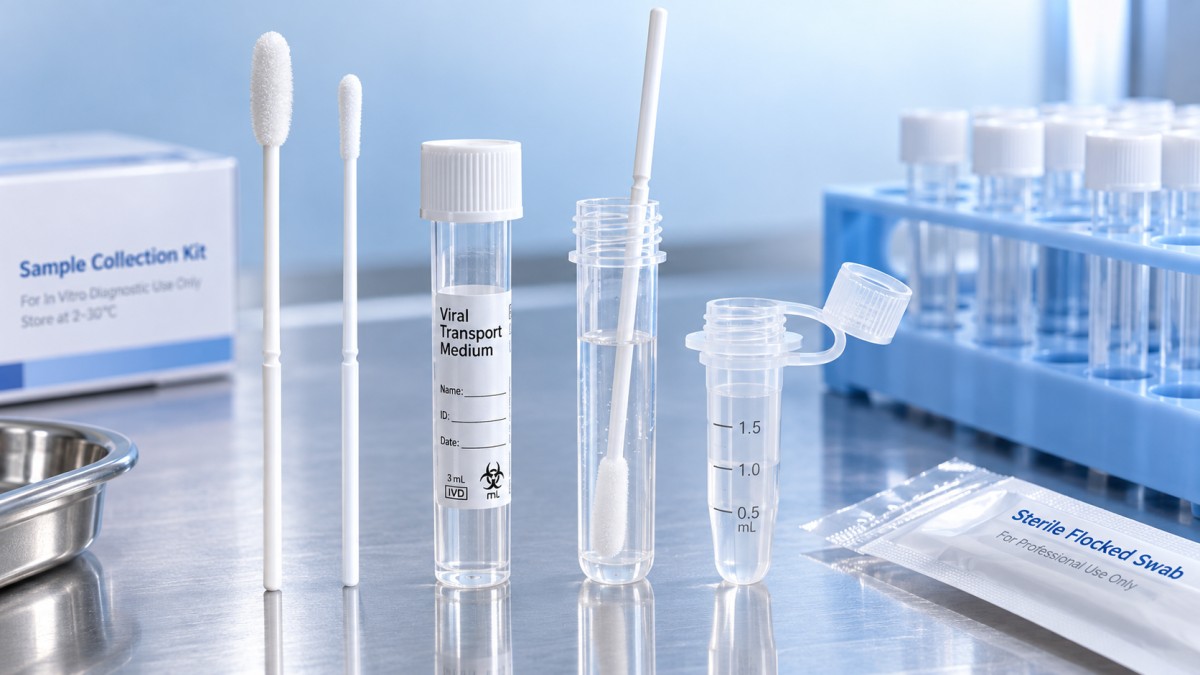
A practical fit assessment should follow the complete sequence from opening the package to transferring the prepared sample. A swab can fit inside a tube yet still be awkward to rotate, squeeze, remove, or use with the required liquid volume.
Decide what the evidence actually supports
Supplier claims such as “PCR compatible,” “medical grade,” or “high collection efficiency” need a defined scope. Useful evidence identifies the exact swab model, the assay or method evaluated, the medium, the processing conditions, and the measured outcomes. Results for a different tip, shaft, or collection system may not apply to the proposed product.
Separate physical suitability, analytical compatibility, and collection performance. These answer different questions:
- Physical suitability shows whether the device can be handled correctly with the specified container and workflow.
- Analytical compatibility addresses inhibition, extraction effects, background signals, or other interference under the evaluated conditions.
- Collection performance addresses whether the swab collects and releases an appropriate specimen during its intended use.
A clean interference result does not prove effective patient sampling. Likewise, a strong positive result does not establish that the candidate preserves performance when the amount of detectable material is low.
Where an alternative is permitted and a comparison study is appropriate, use the currently accepted collection device as the reference. Include negative samples, samples near the assay’s detection threshold, and the intended transport and processing conditions. Define acceptance criteria before testing so the decision reflects the assay’s needs rather than a favorable selection of results.
Contrived samples can help examine release and interference, but they do not fully reproduce patient collection. If the evaluation only measures laboratory extraction, describe its scope accordingly. Do not turn a limited bench comparison into a claim of clinical equivalence.
Internal controls can reveal some processing or amplification problems. They do not necessarily demonstrate that collection captured an adequate specimen. A valid control result therefore should not be treated as proof that a substitute swab performs the collection step properly.
Check supplier documentation before committing to volume
Request a specification tied to the exact catalog number being purchased. It should identify tip and shaft materials, dimensions and tolerances, breakpoint details where relevant, intended sampling site, packaging configuration, sterilization status, shelf life, and storage conditions. A brochure covering an entire swab family is insufficient when individual models differ.
For sterile swabs, review how sterility and package integrity are maintained through the claimed shelf life. Sterility addresses microbial contamination; it does not establish freedom from substances that could interfere with an assay. Those are separate quality questions.
Lot traceability and change notification are particularly valuable for repeat purchasing. A change in fiber source, adhesive, shaft formulation, sterilization process, or packaging may warrant assessment even when the catalog number remains the same. The purchasing agreement should define which changes the supplier must communicate.
For shipments across countries, align the order specification, carton labels, individual packaging, and supporting documents. Check that the receiving site can identify the model, lot, and expiry information without relying on an outer shipping box that may be discarded. Required documentation should match the destination market and intended use.
Quality-system documentation supports supplier assessment, but it does not by itself demonstrate compatibility with a particular COVID testing assay. Keep those two decisions connected without treating them as interchangeable.
Evaluate the swab inside the routine laboratory workflow
A technically suitable swab can still cause avoidable handling problems. Packaging that is difficult to open cleanly, labels that obscure tube identifiers, or shafts that complicate closure can undermine consistent processing. Trial the candidate with the personnel, containers, and equipment used in routine work.
Where collection and testing happen at different locations, include transport and receiving steps in the assessment. Confirm whether the collection site ships a dry swab or a prepared tube, how the laboratory identifies it, and which conditions trigger rejection. A receiving team should not have to infer the collection configuration from the swab’s appearance.
For workflows involving manual liquid transfer, accessory organization is a separate purchasing consideration. For example, Pipette Tip Racks made from autoclavable PP, with snap-lock lids and red or blue racks, can support identification and storage of tip types. Their suitability concerns bench handling; swab compatibility still depends on the collection and assay requirements.
Make the purchasing decision specific enough to repeat
Approve a defined combination: swab catalog number, assay, specimen type, medium or dry-transport arrangement, container, and processing procedure. Attach the relevant specifications and supporting evidence to that decision. This gives purchasing staff a usable reference when a supplier proposes an alternative or a familiar item becomes unavailable.
If several candidates meet the requirements, compare supply continuity, packaging usability, lot consistency, documentation quality, and total handling cost. A lower unit price may offer little value if it introduces additional preparation or increases rejected specimens.
The next useful action is to place the assay instructions beside the candidate’s exact specification. Resolve mismatches before ordering evaluation samples, then assess the remaining candidates in the intended workflow. The result should be a repeatable sourcing decision with clear boundaries for substitution.
Related Posts
Online Message
PROFESSIONAL CONSULTATION
If you are interested in our products and want to know more details, please leave a message here, we will reply you as soon as we can.