


A Photosensitive Microscope Slide has no universal light exposure limit. The applicable limit comes from the product’s validated instructions and must match its light-sensitive material, wavelength range, illumination intensity, and exposure duration. A maximum handling time under specified lighting is meaningful; an isolated lux value without a light source or exposure time is insufficient to establish safe handling.
“Protect from light” also does not define an allowable dose. It establishes a handling or storage precaution. If no numerical limit is supplied, preserve the specified protective conditions and obtain clarification before adopting a routine period of unprotected exposure. Brightness judged by eye, unchanged slide appearance, and successful imaging of one specimen do not establish that performance remains acceptable.
Identify what is sensitive before interpreting the limit
The term “photosensitive slide” can describe different products. The sensitive component might be a fluorescent label on a prepared specimen, a reagent layer, or a coating designed to undergo a photochemical reaction. Ordinary glass is not usually the component responsible for these restrictions. The relevant product documentation therefore needs to identify the sensitive layer and the stage at which protection applies.
These distinctions change the failure mechanism. Fluorescent labels lose signal through photobleaching. A light-reactive coating can undergo unintended conversion before its planned exposure. A reagent-containing surface can develop altered background or reduced activity. Each mechanism requires a different performance endpoint; measuring fluorescence intensity would not adequately assess a coating whose intended function is controlled photochemical conversion.
Sensitivity can also change during preparation. An unused coated slide, a slide carrying an unfixed specimen, and a completed mounted preparation need not share the same exposure tolerance. Coverslipping or mounting does not automatically remove light sensitivity. Use instructions corresponding to the actual preparation stage, including any separate requirements for incubation, drying, storage, and microscopy.
Read exposure specifications as a set of linked conditions
A usable exposure limit describes enough of the illumination conditions to reproduce them. Look for the permitted wavelength range or named light source, intensity at the slide, maximum duration, and required shielding. Temperature and preparation state belong in the interpretation when they affect stability. “Room light” needs clarification if the laboratory’s lighting differs materially from the conditions used to establish the instruction.
Lux is especially easy to misread. Two lamps producing the same lux reading can deliver different amounts of radiation in the wavelengths that affect a particular coating or fluorophore. A source with substantial ultraviolet output can create relevant exposure that a conventional lux meter does not characterize. Substituting an LED lamp for another source therefore requires more than matching apparent brightness.
For constant irradiance, radiant exposure equals irradiance multiplied by time: H = E × t. This relationship calculates incident energy; it does not prove that equal energy produces equal damage. Photochemical behavior, oxygen availability, heating, and intensity-dependent effects can prevent a short, intense exposure from being equivalent to a longer, weaker one. A time limit cannot automatically be rescaled in inverse proportion to lamp intensity.
Translate the instruction into the actual bench conditions
Measure illumination where the sensitive surface sits, with the normal lamp position, filters, and surrounding equipment in place. A measurement at ceiling height or beside the workstation does not represent exposure beneath a task lamp. Keep the detector orientation consistent with the slide plane, and use an instrument whose spectral response and measurement range suit the relevant radiation.
Where instructions identify a sensitive wavelength band, a suitable radiometer or spectral measurement is more informative than a general brightness reading. Instrument calibration and measurement uncertainty matter most when the measured condition approaches a specified boundary. Establish working conditions with enough margin to accommodate routine variation rather than treating a nominal reading exactly at the limit as reliably acceptable.
Windows, microscope illuminators, inspection lamps, and nearby ultraviolet equipment can create exposures absent from the usual overhead-light measurement. Direct sunlight introduces variable intensity and spectrum. An open protective box near a window can therefore experience conditions very different from those of a slide briefly handled beneath controlled bench lighting.
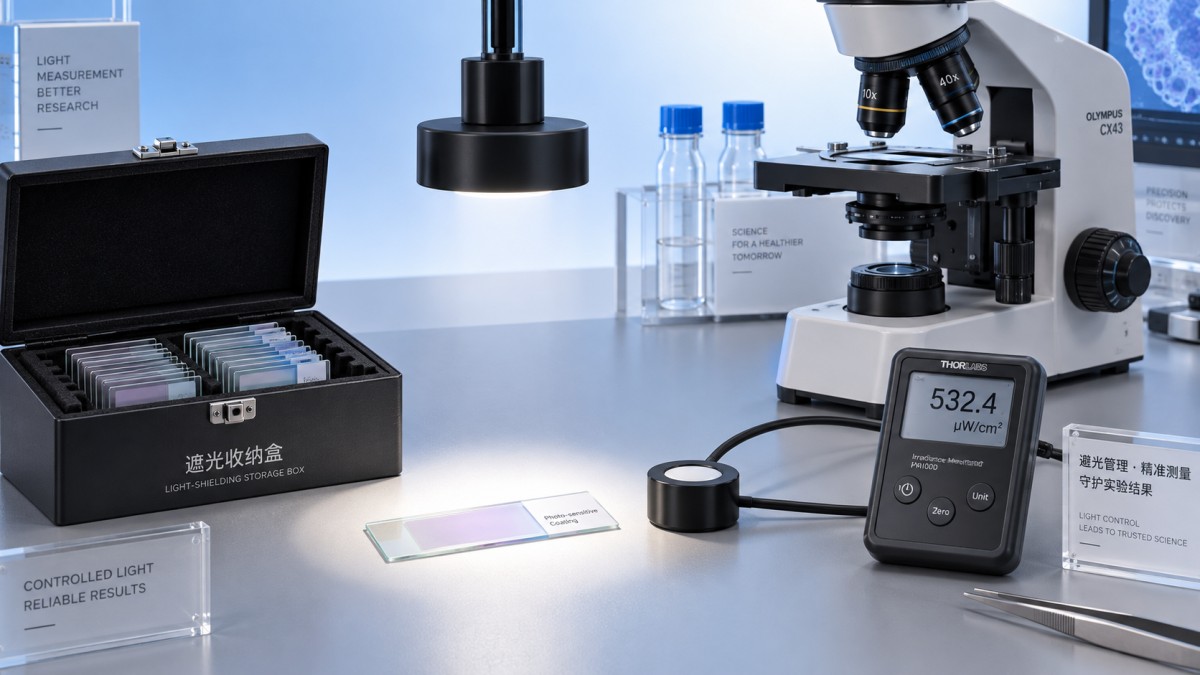
A useful workstation arrangement keeps protected stock away from direct light, exposes only the slide being processed, and provides a covered holding position beside the work area. The transition between these positions deserves attention: slides often accumulate unnecessary exposure while labels are prepared, records are completed, or microscope settings are adjusted.
Separate packaged storage from open-slide handling
A storage instruction applies to the stated packaging configuration. An outer carton, sealed pouch, sleeve, and covered slide box do not necessarily provide equivalent protection. Once a protective layer is removed, the remaining enclosure must be assessed against the handling instructions. A visually dark or amber container offers no assurance of adequate attenuation across every relevant wavelength.
Inspect deliveries without unnecessarily opening the primary light-protective packaging. Record tears, incomplete seals, transparent replacement wrapping, or evidence that slides arrived outside the specified enclosure. Package damage establishes an uncertain exposure history; it does not establish either failure or acceptability. Disposition then requires product-specific guidance or an appropriate performance assessment.
During use, account for repeated exposure intervals. Opening a box for selection, inspecting a slide, transferring it to an instrument, and returning it to storage can contribute to the exposure history. Unless validated instructions establish otherwise, returning a slide to darkness does not erase irreversible photochemical change or restore a handling allowance already consumed.
Specimen identification should remain readable while the sensitive surface stays covered. In a clinical workflow that also uses a Disposable ID Wristband, clear patient markings support identity reconciliation, while the slide and its protective container retain their own specimen identifiers. Complete the identification step before uncovering the slide so that administrative delays do not extend light exposure.
Safelights and microscope illumination require separate decisions
Red or amber lighting is safe only when its emitted spectrum is compatible with the material’s sensitivity and the validated handling conditions. A red safelight suitable for one photosensitive coating can affect another. Filter leakage, lamp output, distance, and duration remain relevant even when the room appears dim. “Safelight” describes a qualified application, not an inherently harmless lamp.
Microscope observation presents a different exposure from room-light handling. Excitation light is concentrated on a small area, and repeated focusing or image acquisition can bleach the region being examined. Whole-slide exposure history and local imaging exposure should therefore be considered separately. A slide kept within its bench-handling allowance can still experience excessive illumination during microscopy.
Where the imaging method permits, locate the specimen using transmitted light or another validated low-exposure mode, close the excitation shutter between acquisitions, and avoid repeatedly illuminating the same field while adjusting settings. Changes to exposure time, illumination power, or acquisition sequence must preserve the method’s required image quality and comparability. Reduced illumination is not useful if it produces an unacceptable measurement.
Establishing a handling window when instructions are incomplete
If documentation supplies only a broad light-protection statement, request the conditions supporting it: the sensitive wavelengths, packaging assumptions, preparation stage, acceptable performance loss, and any validated handling period. An instruction for a related slide or a different fluorescent label is insufficient evidence for the product in question.
Where local verification is appropriate, compare protected reference slides with matched slides exposed under the proposed working conditions. Hold specimen preparation, mounting medium, temperature, elapsed time, and imaging settings consistent. Assess the endpoint relevant to the slide’s intended function, using a pre-established acceptance criterion. Include realistic repeated handling and the upper end of expected workstation illumination.
For a fluorescent preparation, useful endpoints include target signal, background, signal-to-background ratio, and the ability to distinguish a weak positive from a negative control. For a reactive coating, assess the specified functional response. A strong positive alone can conceal a loss that would alter interpretation near the assay’s decision threshold.
The comparison also needs to distinguish light effects from other changes. Evaporation, mounting-medium aging, temperature excursions, and instrument drift can produce declining signal or altered background without being caused by light exposure. Consistent protected references and appropriate controls help identify the cause. A bench-handling verification does not establish a new shelf life or authorize departure from explicit product instructions.
Handle uncertain exposure through evidence
After an exposure excursion, retain the affected slides separately and document the source, estimated duration, distance, shielding, and preparation stage. If the duration is unknown, record that uncertainty instead of assigning a convenient estimate. An intact-looking slide is not sufficient evidence for release because photobleaching or reagent degradation can occur without visible discoloration.
Compare the event with the validated conditions. A room-light handling limit does not resolve an incident involving direct sunlight or ultraviolet illumination. A functional comparison is useful only if it evaluates the affected property with adequate sensitivity; passing a visual inspection cannot substitute for that assessment.
The resulting handling procedure should state the permitted source or wavelength conditions, applicable exposure allowance, protective enclosure, and action when those conditions are exceeded. Reassess its basis after changes to lighting, filters, packaging, slide chemistry, or imaging settings. Those changes can invalidate an established handling window even when the workstation appears unchanged.
Related Posts
Online Message
PROFESSIONAL CONSULTATION
If you are interested in our products and want to know more details, please leave a message here, we will reply you as soon as we can.