


Which specimen container is suitable for formalin-fixed tissue?
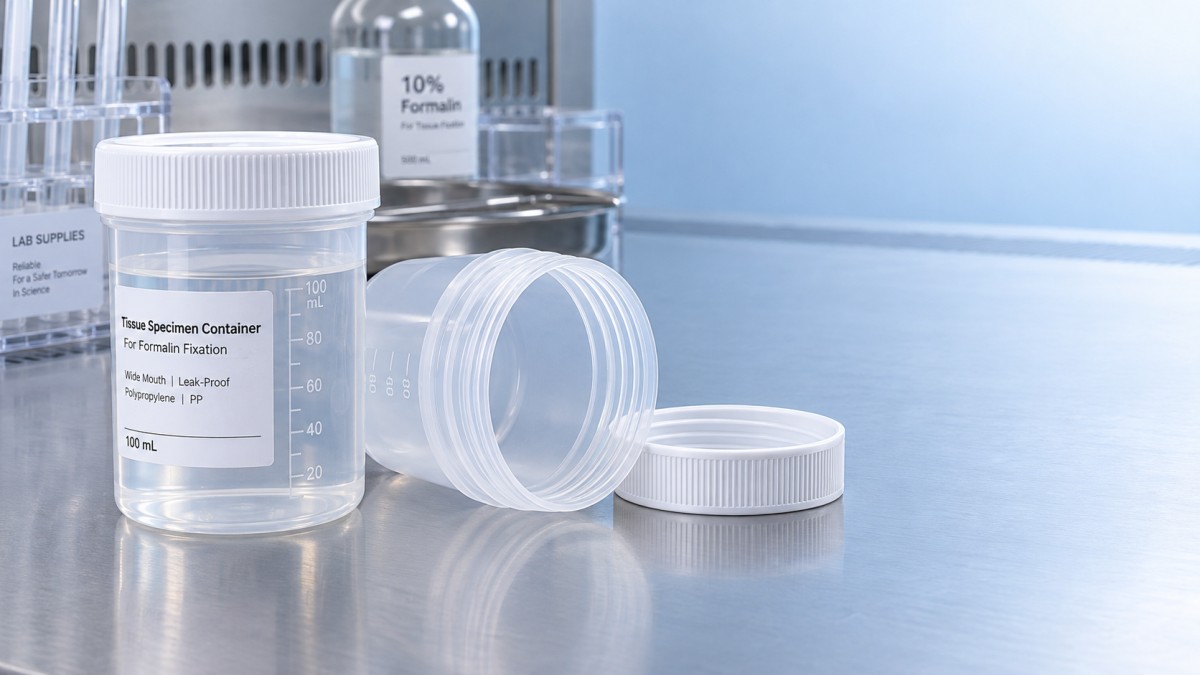
For routine histology, the usual choice is a wide-mouth, formalin-compatible plastic specimen container with a secure, leak-resistant screw cap. Polypropylene and polyethylene containers are common options, provided the manufacturer confirms suitability for the fixative and intended storage conditions. The container should hold the tissue and sufficient fixative without crowding the specimen or filling liquid into the closure.
Choosing a container specimen handlers can trust means looking beyond its stated capacity. A jar that works well for a small biopsy may be awkward for a larger excision. A closure that appears secure on a shelf may leak after repeated opening or transport. Material compatibility, usable volume, labeling space, and the receiving laboratory’s requirements all influence the decision.
There is also an important distinction: tissue being placed into formalin for fixation is not the same as tissue already fixed and awaiting transfer or processing. Both need appropriate containment, but fixation requirements and storage instructions must come from the laboratory protocol, not from the container specification alone.
Start with the specimen and the laboratory’s instructions
Before selecting a jar, confirm whether the specimen belongs in formalin at all. Routine surgical pathology specimens often do, but material intended for microbiology, flow cytometry, frozen section, or certain specialized investigations may require different handling. Putting every tissue sample into formalin can make some requested tests impossible. When the request is unclear, check with the receiving laboratory before adding fixative.
For routine formalin fixation, laboratories commonly use 10% neutral buffered formalin. Despite the name, this is approximately 4% formaldehyde, not 10% formaldehyde. Containers, closures, and any sealing components should be compatible with the actual formulation being used. A general claim of “chemical resistance” is less useful than confirmation for that fixative under the expected contact time and temperature.
Do not assume that a specimen needs to be transferred simply because it has finished fixing. Unnecessary transfers create another opportunity for specimen loss, identification errors, and exposure. Unless the workflow requires a different vessel or storage medium, keeping the tissue in its correctly labeled, suitable container may be the simpler option. Follow the laboratory’s instructions for longer-term storage.
Judge the complete container, not just the plastic
Polypropylene and polyethylene are commonly used for formalin specimen jars. However, naming the resin does not establish the performance of the finished product. Wall thickness, molding quality, cap design, and sealing components also matter. Ask for compatibility information covering the complete container-and-cap assembly rather than accepting a statement about the body material alone.
A wide mouth has a practical advantage: the specimen can enter and leave without being forced through a narrow opening. This matters with fragile tissue, irregular excisions, or specimens whose orientation needs to be preserved. The opening should accommodate the specimen and the handling tools used by the laboratory.
Glass may be chemically suitable in some workflows, but breakage and handling weight make it less convenient for many routine collection and transport tasks. It is not automatically a better choice because it appears more inert. Use it only where the laboratory’s procedure and packaging arrangements support it.
A urine cup or general-purpose sample pot should not be substituted merely because it has a screw lid. Some may be suitable; others may not have validated fixative compatibility or adequate closure performance. Sterility alone does not demonstrate either property.
The cap is often where practical problems begin
Look for threads that engage cleanly, a closure that is manageable with gloves, and a seal that performs as specified when correctly tightened. Cross-threading, damaged sealing surfaces, or tissue caught under the lid can defeat an otherwise appropriate design. Tightening harder is not a reliable remedy and may damage some closures.
If a cap uses a liner or gasket, that component also needs documented compatibility. “Leak-resistant” should not be read as “vapor-tight” or as proof that the jar is approved for every shipping method. Request the supplier’s closure instructions and available leakage test information, especially when specimens travel outside the facility.
Choose capacity from the working volume, not the label
Nominal capacity can be misleading. Tissue displaces liquid, and the container still needs room for safe closure and handling. A jar advertised by its maximum volume may have a lower practical working volume. Check any fill guidance and assess the tissue’s dimensions, not just its estimated weight.
Many routine protocols use approximately ten parts fixative to one part tissue by volume as a starting point. The required amount should nevertheless follow the receiving laboratory’s validated procedure. Enough formalin is needed to surround the tissue; a specimen tightly wedged into a nearly full pot is a poor arrangement even if liquid is visible above it.
For example, a broad, flat excision may need a wider container rather than a taller one of similar capacity. A small biopsy needs a vessel that allows reliable recovery without an unnecessarily large opening or excessive liquid volume. Bigger is not always safer: oversized containers consume more fixative and can make tiny fragments harder to locate.
Container size cannot compensate for unsuitable tissue preparation. Thick specimens may require assessment or dissection by authorized pathology personnel to support fixation. Collection staff should not cut a specimen merely to fit the available jar, particularly where margins or orientation are important. Escalate the mismatch instead.
Prefilled or empty: choose around the collection workflow
Prefilled formalin containers can simplify routine collection by reducing local dispensing and providing a defined starting volume. They are useful where the specimen sizes and procedures are predictable. Check the fixative identity, fill volume, expiry information, and storage instructions. A conveniently sized pot may still contain too little fixative for the tissue being collected.
Empty containers offer more flexibility for larger or irregular specimens, but they move dispensing responsibilities to the facility. That requires appropriate ventilation, protective equipment, spill arrangements, and staff training. The choice should reflect where formalin can be handled safely, not simply the purchase price per container.
Some designs aim to reduce contact with fixative during collection. Evaluate their actual operating steps before adoption: can staff load the specimen, activate the system, confirm adequate liquid contact, and close it correctly while wearing gloves? A closed design may reduce exposure opportunities, but it does not remove the need for the safety data sheet and local chemical-handling procedures.
Labeling and transport are part of suitability
A good container needs enough usable surface for the required patient identifiers, specimen site, and other information specified by the laboratory. Put the primary identification on the container body, not only on the lid. Lids can be exchanged during handling. Where several specimens come from one patient, their sites must remain unambiguous.
Check label adhesion and readability under realistic conditions. Curved walls, condensation, and external fixative contamination can affect performance. Barcode labels should sit where scanners can read them without repeated repositioning. Keep chemical hazard information visible rather than covering it with an oversized patient label.
For movement within a facility, use the required secondary containment rather than relying on the specimen jar alone. For off-site transport, appropriate leakproof secondary packaging, absorbent material, and protective outer packaging may be required. Keep paperwork separate from potential leakage. The precise packaging and documentation requirements depend on the specimen, fixative, route, transport mode, and applicable rules.
Do not assume that formalin fixation automatically makes every shipment unrestricted. Biological classification and chemical transport requirements are separate questions. The fixative formulation and quantity may affect the shipment assessment. Have the responsible shipping personnel confirm the requirements; a supplier’s generic “transport-ready” description is not enough.
Keep product claims tied to their actual application
Laboratories often buy specimen jars alongside slides and other consumables, but suitability should be assessed separately for each workflow. For example, Auto-Smear Microscope Slides are intended for automatic blood-smear applications. Their stated dimensions are 25.0 mm × 75.0 mm, with a thickness of 1.0–1.2 mm, and their surface cleanliness and wettability are controlled for that use. Those characteristics do not establish suitability as tissue containers or automatically qualify the slides for a histology process.
The same discipline applies when sourcing internationally. In our medical-device export work with healthcare institutions, laboratories, and distributors, quality and reliable service begin with matching the supplied item to its intended task. For formalin containers, useful support means clear material and closure information, consistent specifications, and documentation relevant to the destination market—not a broad assurance that a product is “medical grade.”
A practical acceptance check before routine use
Before introducing a new container, review samples with the people who collect, transport, receive, and open them. A purchasing specification may miss a lid that is difficult to grip or a label area that does not fit the laboratory’s barcode format.
- Confirm compatibility of the body, cap, and any seal with the actual fixative.
- Check usable capacity and mouth width against representative specimen sizes.
- Assess closure operation with gloves and follow an approved leakage-assessment procedure.
- Verify label placement, barcode readability, and fit within secondary packaging.
- Confirm that instructions, fixative documentation, and transport arrangements are available.
The suitable choice is therefore usually a wide-mouth, formalin-compatible plastic jar with a dependable screw closure—but only when its working volume, identification space, and handling requirements fit the specimen. If tissue must be squeezed through the opening, the lid will not seat cleanly, or the fixative compatibility is unclear, stop and select a better-matched container before collection or transfer.
Related Posts
Online Message
PROFESSIONAL CONSULTATION
If you are interested in our products and want to know more details, please leave a message here, we will reply you as soon as we can.