


Why do hemacytometer counts still go wrong even when the math is correct?
Because most counting errors happen before the calculation step. Hemacytometers for blood cell counting are simple in principle, but they are unforgiving in practice. A chamber that is slightly overfilled, a sample that was not mixed well enough, or a coverslip that is not seated properly can shift the final result more than many users expect.
That is why two operators can use the same sample, follow the same dilution ratio, and still get different numbers. The issue is usually not the formula. It is technique, consistency, and how well the operator controls small variables from sample preparation through final counting.
What is the most overlooked step before loading the chamber?
Mixing the sample properly is high on the list. Blood cells settle quickly, especially if the sample stands for even a short time. If you draw from the top without re-suspending the cells evenly, the count may look clean and precise while being fundamentally wrong.
The goal is gentle but complete mixing. Too little mixing gives uneven distribution. Too much force can create bubbles or damage fragile cells in some applications. In routine work, it helps to standardize how many inversions or mixing motions are used before pipetting, rather than leaving it to habit.
This same thinking applies upstream during specimen handling. If collection or transfer is sloppy, counting accuracy suffers later. In workflows where contamination control and sample visibility matter, devices such as Transport Tube with Swab Capture Cap fit naturally into good lab practice because secure containment, clear viewing, and easier identification reduce handling confusion before analysis even begins.
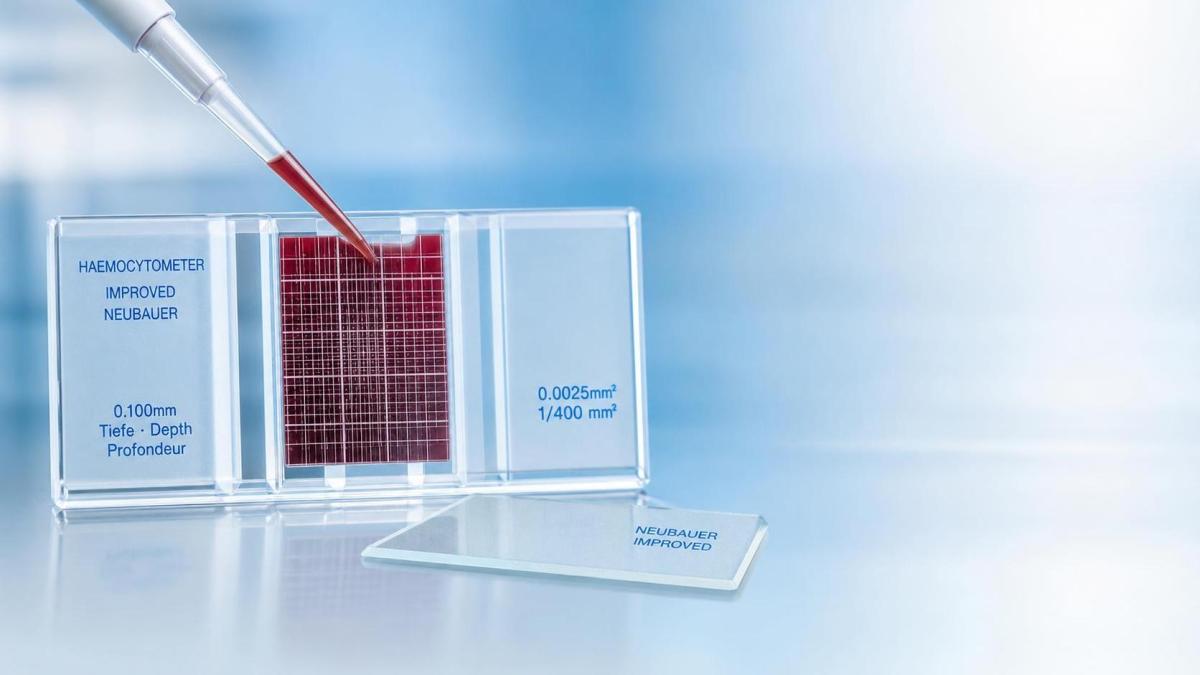
Does chamber loading technique really make that much difference?
Yes. A lot. This is one of the biggest reasons Hemacytometers for blood cell counting produce operator-to-operator variation.
The chamber should fill by capillary action. If the liquid is pushed in aggressively, the depth may become uneven. If too little sample enters, the grid area is not filled correctly. If too much enters, fluid can flow into surrounding channels and distort the counting volume.
Watch for these warning signs:
- Air bubbles over the grid
- Fluid leaking beyond the chamber boundary
- Visible streaking or patchy cell distribution
- Different appearance between the two sides of the chamber
If any of those appear, it is usually better to clean the chamber and reload rather than count a questionable preparation.
How much does the coverslip matter?
More than many new users realize. The hemacytometer depends on a defined chamber depth, and that depth is created only when the correct coverslip is seated correctly. A standard slide cover is not always an acceptable substitute.
If the coverslip is tilted, dirty, chipped, or not making proper contact, the chamber depth changes. Once that happens, the count is no longer tied to the expected volume. You may still get a number, but the result cannot be trusted.
A quick visual check helps: the coverslip should sit evenly, and the characteristic interference pattern should appear when it is properly positioned. Operators who skip this check often lose accuracy without realizing where the problem started.
Is dilution error usually obvious?
Not at all. That is what makes it dangerous. A dilution error often looks like a normal count until someone compares it with a repeat or with instrument-based results.
The safest approach is to treat dilution as a controlled step, not a casual one. Check the pipette range, confirm the target ratio, and use the same sequence every time. If the sample is too concentrated, crowded cells make boundary decisions harder. If it is too dilute, statistical variation becomes more pronounced because too few cells are counted.
A practical target is not just “countable,” but “comfortably countable.” The grid should contain enough cells for a stable result without turning the field into a cluster where individual cells are difficult to distinguish.
Which counting mistakes cause the most inconsistency?
Boundary handling is a common one. If one user counts cells touching the top and left lines, while another counts the bottom and right, the totals drift. This is why labs need a fixed inclusion rule and should train every operator to apply it the same way.
Another source of inconsistency is switching counting areas depending on what looks easiest in the moment. That may feel efficient, but it weakens comparability. Decide in advance which squares will be counted for a given application and stick to that rule.
When should you suspect the result is not reliable?
Usually before the final calculation is even finished. Experienced operators learn to distrust certain patterns immediately.
- One side of the chamber looks much denser than the other
- Cells are clumped, especially near edges
- Debris makes cell identification uncertain
- The sample dries during counting
- Replicate counts differ more than your lab normally accepts
When that happens, the answer is not to average everything and hope it balances out. Go back to the preparation step, identify what was unstable, and repeat under controlled conditions.
Can timing affect blood cell counts on a hemacytometer?
Yes, especially between mixing, dilution, chamber loading, and actual counting. Letting the loaded chamber sit too long can allow cells to settle unevenly or the sample to start drying at the edges. Counting too quickly after loading can also be a problem if the cells have not distributed evenly across the grid.
The fix is simple: build a routine with consistent timing. Not “fast,” not “slow,” just repeatable. A written work instruction often helps more than relying on individual memory.
Does chamber cleanliness affect accuracy, or is that mostly a maintenance issue?
It affects the count directly. Residue, lint, fingerprints, or dried sample can interfere with capillary filling and make cells harder to distinguish from artifacts. A scratched chamber can create the same problem repeatedly and is easy to miss if users assume the issue is with the sample.
Cleanliness is not just about appearance. It is about preserving the known geometry of the counting area and making sure the operator is looking at cells, not contamination or residue.
What should operators standardize if they want better repeatability?
Focus on the steps that create variation, not the steps that only look technical. In most labs, repeatability improves when the team standardizes:
- Sample mixing method before pipetting
- Dilution ratio and pipetting sequence
- Waiting time after chamber loading
- Squares selected for counting
- Boundary inclusion rule
- When to reject and reload a chamber
If specimens must be moved between collection and testing sites, stable identification and contamination protection also matter. A self-standing tube with clear sample visibility, frosted writing surface, and options such as assembled or separate packaging can make handling cleaner and easier in transit-sensitive workflows, which is where a product like Transport Tube with Swab Capture Cap becomes relevant.
Should you trust one good-looking count?
Not automatically. A neat-looking field can still come from poor mixing or bad dilution. The more reliable question is whether the result fits the whole process: uniform loading, clear cells, consistent boundary handling, and reasonable agreement between repeat counts.
For operators using Hemacytometers for blood cell counting, the best habit is to treat accuracy as a chain. If one link is weak, the final number becomes less meaningful no matter how carefully you calculate it. Start by controlling the physical steps you can see. The arithmetic will take care of itself once the chamber, sample, and counting rule are all under control.
Related Posts
Online Message
PROFESSIONAL CONSULTATION
If you are interested in our products and want to know more details, please leave a message here, we will reply you as soon as we can.